To split a bill fairly, first decide what “fair” means for this bill: equal use, different use, or an agreed ratio. If everyone used roughly the same amount, split it equally. If people ordered or used clearly different things, split it by item. If the group agreed on a ratio ahead of time (such as income, room size or household size), use a percentage or weighted split.
The math behind each method is simple. The harder part is picking the method before the bill arrives, so nobody feels ambushed at the end. This guide compares the five common ways to split a bill, shows the formula for each, and walks through a restaurant, a household and a trip example so you can see which one fits your situation.
The five ways to split a bill
Most bill-splitting disagreements come from people silently assuming different methods. One friend assumes an equal split, another assumes everyone pays for what they ordered. Naming the method removes that friction.
| Split Method | Best For | Main Advantage | Main Limitation |
|---|---|---|---|
| Equal split | Similar orders, shared platters, group activities | Fastest and easiest to check | Unfair when spending differs a lot |
| Itemized (exact) split | Restaurant bills with very different orders | Everyone pays for what they used | Takes longer; shared items and tax need extra steps |
| Percentage split | Ongoing costs with an agreed ratio, such as income-based splits | Easy to express a policy like 60/40 | Percentages must total exactly 100 |
| Weighted shares | Groups of different sizes, such as couples and solo travelers | Weights never need to add to 100 | Everyone must agree on what a weight means |
| Custom (fixed + remainder) | One person contributes a set amount, the rest is shared | Flexible for gifts and partial participation | Easy to get wrong without a clear record |
None of these is universally the best. The right choice depends on how different people’s use was, how much the difference is worth arguing about, and whether the split repeats every month.
Equal split
An equal split divides the total by the number of people.
Share per person = Total ÷ Number of people
This is the default for good reason. It is fast, anyone can check it on a phone, and it works well when orders are similar or when the group shared most things. A pizza night where everyone ate from the same boxes is a natural equal split.
The problem appears when use is uneven. If one person had a salad and water while another had a steak and two cocktails, an equal split quietly asks the light spender to subsidize the heavy spender. Over one dinner that may be a few dollars. Over a year of group dinners it adds up, and it is a common source of resentment.
Use an equal split when:
- Orders or usage are within a few dollars of each other.
- Most of the bill was shared (platters, a rental, a shared activity).
- Speed matters more than precision, and the group rotates often enough that small differences even out.
When the total does not divide evenly into cents, someone pays one extra cent. Pick who that is in a visible, repeatable way (for example, the first person on the list, rotating each time) so the shares still add up to the exact bill.
Itemized (exact) split
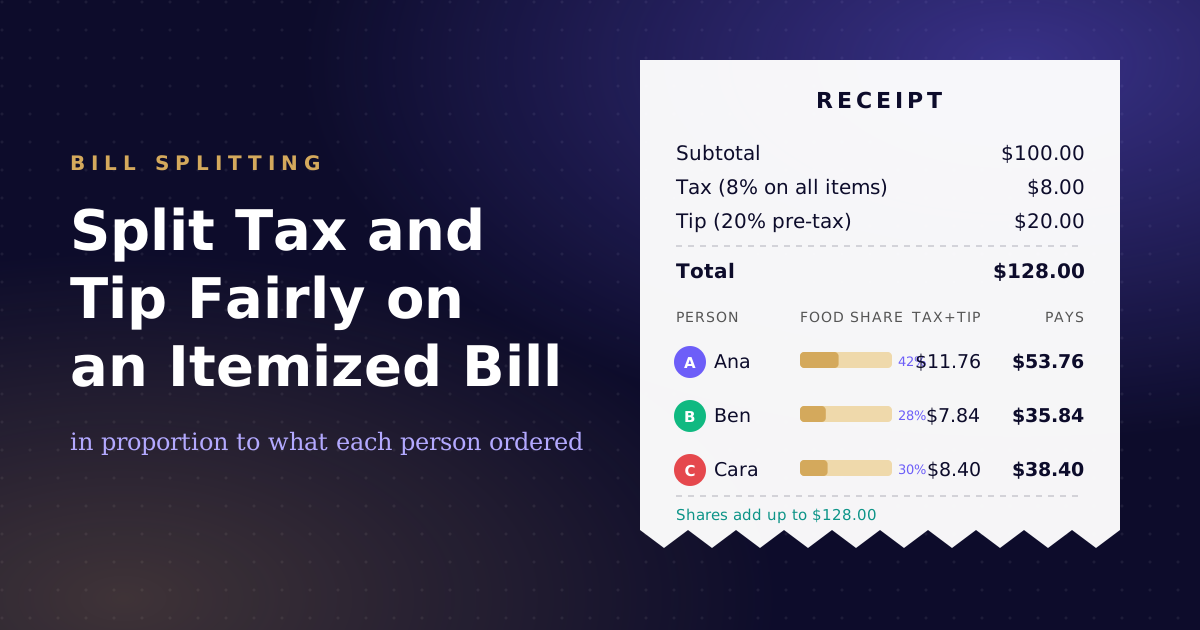
An itemized split charges each person for the specific items they used. Shared items are divided among the people who shared them. Tax and tip are then spread in proportion to each person’s item subtotal.
Person’s item subtotal = Their own items + Their portion of shared items
Person’s share = Person’s item subtotal × (Bill total ÷ Item subtotal)
That second formula is the key step people skip. If you only add up items, the tax and tip are left over and someone has to cover them. Scaling each subtotal by the same factor spreads tax and tip in proportion to what each person ordered.
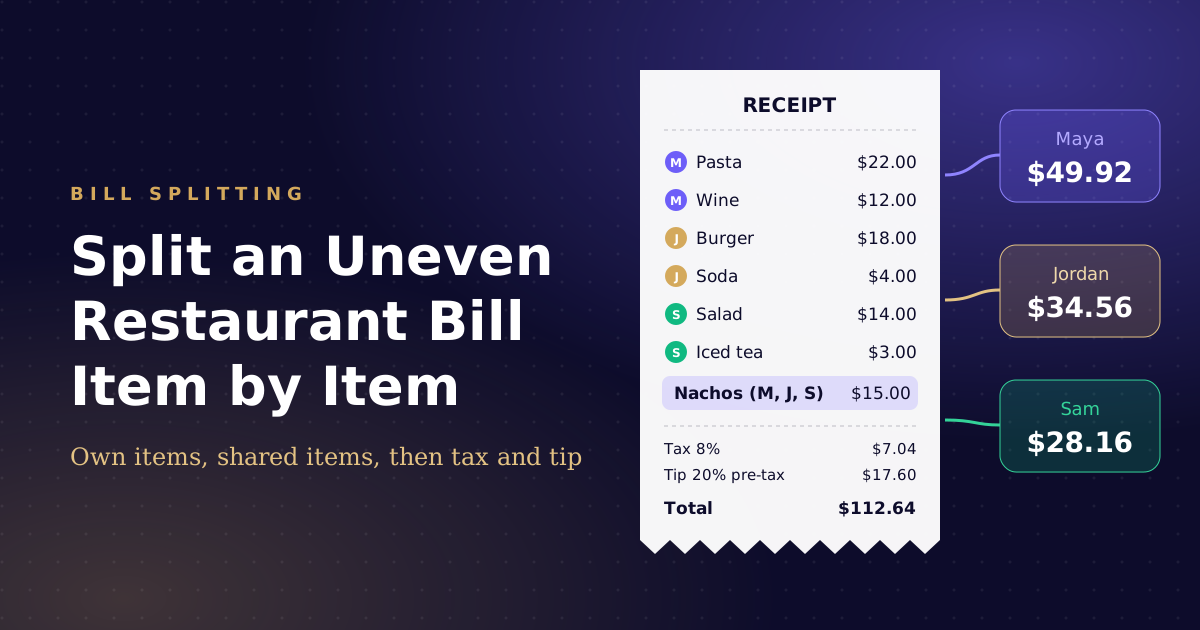
Itemized splits are the most accurate, but they take time. They also require decisions about shared items (who shared the appetizer?) and about how the tip is calculated. For a detailed restaurant walk-through, see how to split a restaurant bill unevenly.
Use an itemized split when:
- Orders differ by more than the group is comfortable absorbing.
- Some people did not drink alcohol, skipped dessert or joined late.
- You have an itemized receipt and a few minutes to work through it.
Percentage split
A percentage split assigns each person a fixed percentage of the total.
Share = Total × Percentage ÷ 100
Percentages work well for recurring costs where the group has already agreed on a ratio: a couple splitting shared expenses by income, or housemates splitting a shared bill in proportion to room size. The ratio is set once and applied every month.
Two checks keep a percentage split honest:
- The percentages must add up to exactly 100. If they add to 99 or 101, the group will collect too little or too much. Three equal thirds cannot all be written as 33.33%, because 33.33 × 3 = 99.99. Use 33.33, 33.33 and 33.34 instead, and say openly who carries the extra 0.01%.
- Round only the final amounts. Calculate each share at full precision, round to cents at the end, and check that the rounded shares add back to the original total. If they do not, adjust by one cent in a way everyone can see.
Percentages feel precise, but that precision is only as good as the agreement behind it. A 60/40 income split can be fair for one couple and uncomfortable for another. The article on how couples can split expenses looks at 50/50 versus proportional-to-income splits in more depth.
Weighted shares
A weighted split gives each person a number of shares instead of a percentage. The shares are converted into fractions of the total automatically.
Person Share = Total × Person Weight ÷ Total Weight
For example, weights of 1, 1 and 2 add up to 4. The first two people pay 1 ÷ 4 = 25% each, and the third pays 2 ÷ 4 = 50%.
Weights are easier to agree on than percentages because they describe something real: “a couple counts as two people,” “the person with the big bedroom counts as 1.5,” “the person who stayed two nights counts as 2.” You never have to check that the weights add up to 100. You just add them and divide.
Use weighted shares when:
- The group contains units of different sizes (families, couples, solo travelers).
- You are splitting by a countable measure such as nights, meals or seats.
- You want a rule that still works when someone joins or leaves, because you only change one weight.
The main risk is disagreement about what a weight means. Agree on the rule (“one share per adult”) before anyone spends money.
Custom shares (fixed amount plus remainder)
Sometimes one or more people contribute a set amount and the rest is shared. A person who only joined for coffee might pay a flat $10. A person who offered to cover $25 of a group gift pays exactly that.
Remaining amount = Total − Fixed contributions
Each sharing person pays = Remaining amount ÷ Number of people sharing
Custom splits are flexible, but they are also where mistakes hide. Write the fixed amounts down first, subtract them, and only then divide the remainder. Always finish with a total check: fixed amounts plus shared amounts must equal the original bill.
Fairness versus simplicity
Every method trades accuracy against effort. A useful way to decide is to ask how much money the “unfair” part actually represents.
- Small gap, one-off event: An equal split is usually fine. Arguing over $3 costs more goodwill than the $3 is worth.
- Large gap, one-off event: Itemize. If one person’s items are $20 higher than another’s, that is worth five minutes.
- Repeating costs (rent, bills, groceries): Agree on a percentage or weighted rule once, write it down, and apply it every time. The effort is front-loaded, and small unfairness does not compound month after month.
- Mixed situations: Combine methods. Split the shared platters equally among everyone, then add each person’s individual items on top.
Fairness also has a social side. A method people understand and agreed to in advance usually feels fairer than a more precise method sprung on them at the end of the night.
Worked example 1: a restaurant dinner, equal versus itemized
Four friends (Ana, Ben, Cal and Dee) have dinner.
Known values:
- Ana: $32 entrée. Ben: $18 entrée. Cal: $24 entrée. Dee: $26 entrée.
- A $16 appetizer shared by all four ($4 each).
- Item subtotal: $116.00.
- Assume an 8% sales tax on all food items: $116.00 × 0.08 = $9.28.
- Assume a 20% tip calculated on the pre-tax subtotal: $116.00 × 0.20 = $23.20.
- Bill total: $116.00 + $9.28 + $23.20 = $148.48.
Option A, equal split.
- Formula: Share = Total ÷ Number of people
- Calculation: $148.48 ÷ 4 = $37.12
- Rounded result: $37.12 each
- Total check: $37.12 × 4 = $148.48
Option B, itemized split.
- Formula: Share = Person’s item subtotal × (Bill total ÷ Item subtotal)
- Scaling factor: $148.48 ÷ $116.00 = 1.28
| Person | Items | Share of appetizer | Item subtotal | × 1.28 | Final share |
|---|---|---|---|---|---|
| Ana | $32.00 | $4.00 | $36.00 | $46.08 | $46.08 |
| Ben | $18.00 | $4.00 | $22.00 | $28.16 | $28.16 |
| Cal | $24.00 | $4.00 | $28.00 | $35.84 | $35.84 |
| Dee | $26.00 | $4.00 | $30.00 | $38.40 | $38.40 |
| Total | $116.00 | $148.48 |
Total check: $46.08 + $28.16 + $35.84 + $38.40 = $148.48. Nothing is left over.
Interpretation: Under an equal split, Ben pays $37.12 for a meal whose fair itemized cost was $28.16, so he covers $8.96 of other people’s food. Ana pays $37.12 instead of $46.08. Whether that $8.96 gap matters is a group decision, but seeing both numbers makes the conversation concrete. If the group had four similar entrées, the two methods would give nearly identical results and an equal split would be the obvious choice.
Worked example 2: a household with a percentage split
Three housemates share a combined monthly household cost of $1,850 (rent, internet and utilities together). They agreed on a 45% / 35% / 20% split based on room size and use: Maya has the largest room with a private bathroom, Jordan has a medium room, and Priya has the smallest room.
Known values: Total $1,850.00; percentages 45, 35 and 20 (sum = 100).
Chosen method: Percentage split.
Formula: Share = Total × Percentage ÷ 100
Calculation:
- Maya: $1,850 × 45 ÷ 100 = $832.50
- Jordan: $1,850 × 35 ÷ 100 = $647.50
- Priya: $1,850 × 20 ÷ 100 = $370.00
Rounded result: No rounding needed; each share is already a whole number of cents.
Total check: $832.50 + $647.50 + $370.00 = $1,850.00.
Interpretation: The percentage rule is set once and reused every month, which is exactly where percentage splits shine. If the housemates had instead chosen equal thirds, the percentages would be 33.33%, 33.33% and 33.34%. On a $100 bill that gives $33.33, $33.33 and $33.34, which adds back to exactly $100.00. The person with the 33.34% carries the extra cent, and the group can rotate who that is each month.
Room size is only one way to set a household ratio. For a deeper look at equal, income-based and room-size approaches, read how to split rent fairly between roommates.
Worked example 3: a trip with weighted shares
Four travelers on a weekend trip put $480 into a shared food fund. Two of them (Ana and Ben) are solo travelers. The other two (Cal and Dee) are a couple who share one budget and want to be treated as one party with two people.
Known values: Total $480.00. Parties: Ana (weight 1), Ben (weight 1), Cal and Dee as one couple (weight 2). Total weight = 4.
Chosen method: Weighted shares.
Formula: Person Share = Total × Person Weight ÷ Total Weight
Calculation:
- Ana: $480 × 1 ÷ 4 = $120.00 (25%)
- Ben: $480 × 1 ÷ 4 = $120.00 (25%)
- Cal and Dee: $480 × 2 ÷ 4 = $240.00 (50%)
Rounded result: $120.00, $120.00 and $240.00.
Total check: $120 + $120 + $240 = $480.00.
Interpretation: The weights say exactly what the group agreed: one share per person, with the couple settling up as a unit. Nobody had to work out that the couple’s share is 50%; the weights did it.
When weights do not divide evenly
Weighted splits often produce fractions of a cent. Suppose a larger group of five parties shares $250 of groceries: three solo travelers with weight 1 and two couples with weight 2. Total weight = 1 + 1 + 1 + 2 + 2 = 7.
- Each solo traveler: $250 × 1 ÷ 7 = $35.714…
- Each couple: $250 × 2 ÷ 7 = $71.428…
Rounding everyone down gives $35.71 × 3 + $71.42 × 2 = $249.97, which leaves 3 cents unassigned. A transparent fix is to give the leftover cents to the shares that were rounded down the most. The couples lost about 0.86 of a cent each and the solo travelers about 0.43 of a cent each, so both couples get one extra cent and one solo traveler gets the third.
| Party | Weight | Raw share | Final share |
|---|---|---|---|
| Solo traveler 1 | 1 | $35.714… | $35.72 |
| Solo traveler 2 | 1 | $35.714… | $35.71 |
| Solo traveler 3 | 1 | $35.714… | $35.71 |
| Couple 1 | 2 | $71.428… | $71.43 |
| Couple 2 | 2 | $71.428… | $71.43 |
| Total | 7 | $250.00 | $250.00 |
Total check: $35.72 + $35.71 + $35.71 + $71.43 + $71.43 = $250.00.
Worked example 4: a custom split for a group gift
Four coworkers buy a $60 farewell gift. Sam offers to put in a fixed $25 because the gift was Sam’s idea. The other three split whatever is left.
Known values: Total $60.00. Fixed contribution: Sam $25.00. Sharing people: 3.
Chosen method: Custom split (fixed amount plus equal remainder).
Formula: Remaining = Total − Fixed contributions; Each sharing person pays Remaining ÷ Number sharing.
Calculation: $60.00 − $25.00 = $35.00. Then $35.00 ÷ 3 = $11.666…
Rounded result: $11.67, $11.67 and $11.66. Two people carry the extra cent between them.
Total check: $25.00 + $11.67 + $11.67 + $11.66 = $60.00.
Interpretation: Subtracting the fixed amount first keeps the math clean. If you divided $60 by 4 and then tried to adjust Sam’s share afterward, it would be easy to lose track of a few dollars.
Pros and cons at a glance
Equal split
- Pros: fastest, easy to verify, no receipt analysis.
- Cons: ignores real differences in spending; can feel unfair to light spenders.
Itemized split
- Pros: most accurate for one-off meals; everyone pays for their own choices.
- Cons: slower; needs rules for shared items, tax and tip.
Percentage split
- Pros: clear policy for recurring costs; easy to explain as a ratio like 60/40.
- Cons: must add to exactly 100; residual cents need a visible rule.
Weighted shares
- Pros: intuitive for groups of different sizes; adding or removing a person means changing one weight.
- Cons: the meaning of a weight must be agreed in advance.
Custom split
- Pros: handles fixed contributions and partial participation.
- Cons: easy to miscount; always end with a total check.
How to choose a method in four questions
- Did everyone use roughly the same amount? If yes, split equally.
- Is the difference in use large and easy to measure (like a receipt)? If yes, itemize.
- Is this a recurring cost with an agreed ratio? If yes, use a percentage or weighted split and write the rule down.
- Did someone commit to a fixed amount? If yes, subtract it first and split the rest.
You can mix methods on one bill. Many groups split shared dishes equally and add personal items on top, which is simply an itemized split where some items belong to everyone.
Putting the method into practice
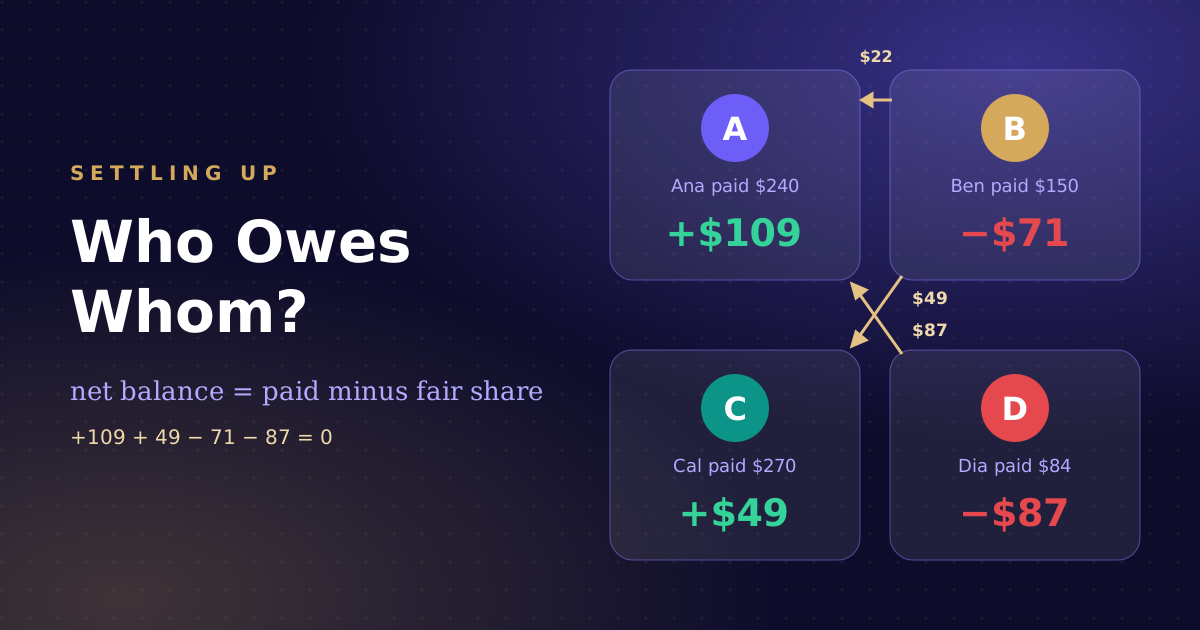
The Split Calculator on our homepage handles the arithmetic once you know your method. It lets you add people and expenses, choose who paid each expense and tick who shares it. Each expense is split equally among the ticked people, all math is done in whole cents, and the final shares always add up to the exact total. It then shows each person’s balance and who pays whom.
Here is how each method maps onto the calculator:
- Equal split: add the bill as one expense and tick everyone.
- Itemized split: add each item (or group of items) as its own expense and tick only the people who shared it. Add tax and tip as a separate expense if you want everyone to share it equally, or fold them into each person’s items first using the scaling factor above if you want them proportional.
- Percentage or weighted split: the calculator has no percentage or weight fields. Work out each person’s share with the formula in this article, then enter each share as its own expense, paid by whoever paid the bill and shared only by that one person.
- Custom split: enter the fixed contribution as one expense shared by that person, and the remainder as another expense shared by everyone else.
Agree on the method first, run the numbers, and check that the shares add back to the total. That order of steps prevents most of the arguments that make splitting a bill feel harder than it is.