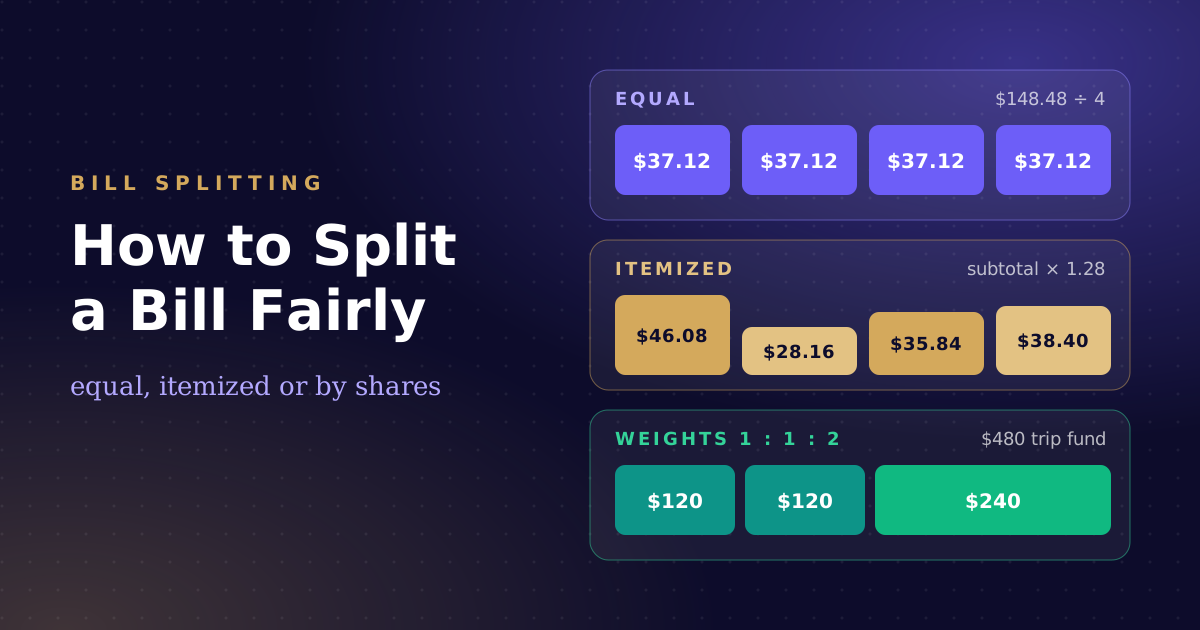
Rounding creates leftover cents because most totals do not divide evenly into whole cents. $100 ÷ 3 = $33.333…, and nobody can pay a third of a cent. If all three people pay $33.33, the group collects $99.99 and $0.01 is still owed. The fix is simple: round everyone down to whole cents, then hand out the leftover cents one at a time using a rule the group agrees on, so the shares add up to exactly $100.00.
The rest of this guide explains where the remainder comes from, how to assign it fairly, how to handle percentage and weighted splits where the leftovers are uneven, and what to do in cash or in currencies without cents.
Why leftover cents happen
Money has a smallest unit. In US dollars that unit is one cent, so every payment must be a whole number of cents. Division does not respect that limit. Any time the total in cents is not a multiple of the number of people, the exact share has a fractional part that cannot be paid.
There are only three ways to deal with that fraction:
- Round everyone up. Each person pays $33.34, the group collects $100.02, and the payer receives 2 cents more than the bill.
- Round everyone down. Each person pays $33.33, the group collects $99.99, and the payer is 1 cent short.
- Round down, then distribute the remainder. Two people pay $33.33, one pays $33.34, and the group collects exactly $100.00.
Only the third option keeps the books balanced. A one-cent error sounds trivial, but when a group splits dozens of expenses over a trip, or a household splits bills every month, small errors add up and make balances impossible to reconcile.
Round to currency precision at the end, not the middle
A common mistake is rounding at each step. If you round every item, every tax amount and every tip portion to cents as you go, the small errors pile up. The rule that prevents this:
Keep full precision through every calculation. Round to cents only once, at the final share.
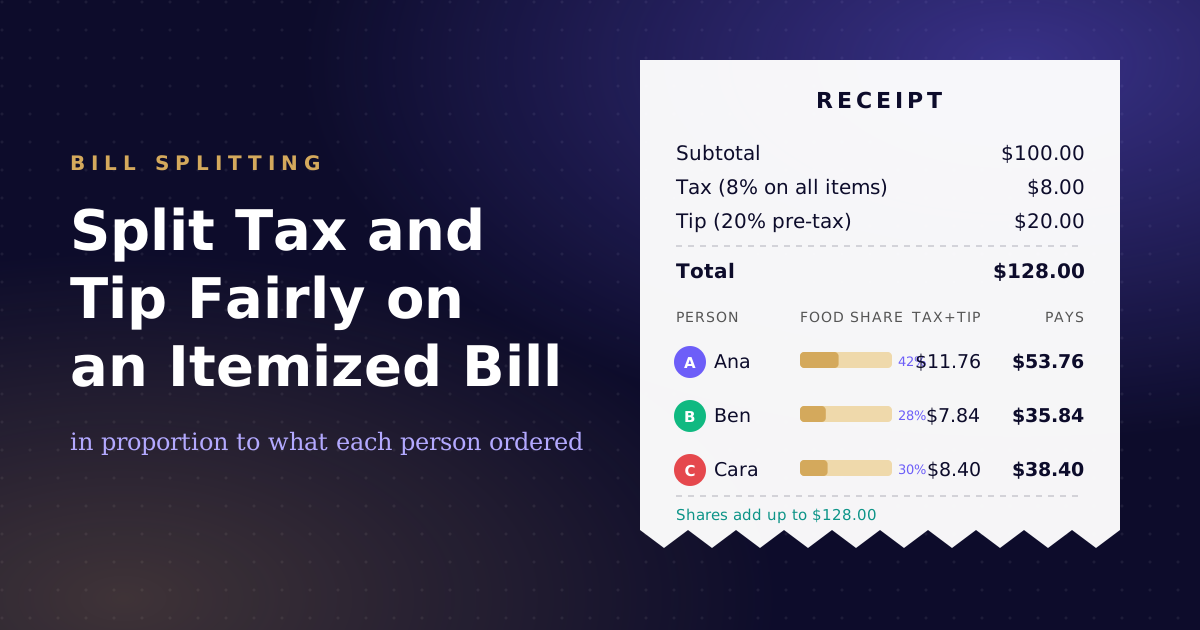
For example, if you calculate each person’s portion of tax and tip, keep the unrounded values, add them to the item costs, and only then round the final amount each person owes. Our guide on how to split tax and tip fairly uses this same principle for proportional tax and tip.
Integer cent arithmetic: the reliable method
The cleanest way to avoid rounding errors is to stop working in dollars and work in whole cents (the “minor unit” of the currency).
Step 1. Convert the total to cents: $100.00 = 10,000 cents.
Step 2. Divide by the number of people and keep the whole-number part and the remainder: 10,000 ÷ 3 = 3,333 with a remainder of 1.
Step 3. Give everyone the base amount (3,333 cents), then give one extra cent to as many people as the remainder (1 person).
Step 4. Convert back to dollars and check the total.
| Person | Raw Share | Rounded Share |
|---|---|---|
| Person 1 | $33.333… | $33.34 |
| Person 2 | $33.333… | $33.33 |
| Person 3 | $33.333… | $33.33 |
| Total | $100.00 | $100.00 |
The remainder is always smaller than the number of people, so for an equal split no one ever pays more than one extra cent. Working in integers also avoids the floating-point quirks that can make a spreadsheet or a phone calculator show $33.330000000001.
Base share = Total in cents ÷ Number of people (whole-number part)
Extra cents to hand out = Total in cents − Base share × Number of people
Who gets the extra cent?
The math tells you how many extra cents exist. It does not tell you who pays them. That is a group decision, and it matters more for trust than for money. Common deterministic rules:
- First on the list. Whoever is listed first (alphabetically, or in the order names were entered) takes the extra cent. Easy and predictable.
- The organizer or payer. The person who paid the bill absorbs the difference, often by rounding their own share. Many people prefer this because they are the one receiving the money anyway.
- Rotation. On each new bill, the extra cent moves to the next person on the list. Over time, everyone carries the same number of extra cents.
What matters is that the rule is deterministic: the same inputs always produce the same answer, and anyone in the group can check it. A rule like “whoever notices pays it” feels casual but leads to confusion when two people run the numbers and get different results.
Rotating the extra cent across bills
Suppose three housemates split a $100 internet bill every month. Each month there is one extra cent. With rotation:
| Month | Alex | Blake | Casey | Total |
|---|---|---|---|---|
| January | $33.34 | $33.33 | $33.33 | $100.00 |
| February | $33.33 | $33.34 | $33.33 | $100.00 |
| March | $33.33 | $33.33 | $33.34 | $100.00 |
| Three-month total | $100.00 | $100.00 | $100.00 | $300.00 |
After three months, everyone has paid exactly $100.00. The rotation turns a small unavoidable imbalance into a perfectly even result over time.
Edge cases worth checking
The integer method works for any total and any group size. These examples show how it behaves when the numbers get awkward.
$10 between 6 people
Known values: Total $10.00 = 1,000 cents. People: 6.
Calculation: 1,000 ÷ 6 = 166 with a remainder of 4.
Rounded result: Four people pay $1.67 and two people pay $1.66.
Total check: 4 × $1.67 + 2 × $1.66 = $6.68 + $3.32 = $10.00.
Interpretation: Here most of the group pays the extra cent. If everyone paid $1.67, the group would collect $10.02; if everyone paid $1.66, it would collect $9.96. Neither is correct.
$0.01 between 3 people
Known values: Total $0.01 = 1 cent. People: 3.
Calculation: 1 ÷ 3 = 0 with a remainder of 1.
Rounded result: One person pays $0.01 and two people pay $0.00.
Total check: $0.01 + $0.00 + $0.00 = $0.01.
Interpretation: It looks silly, but it is a good test of any splitting method. A method that rounds each share to the nearest cent gives $0.00 to everyone and loses the cent entirely.
$999.99 between 7 people
Known values: Total $999.99 = 99,999 cents. People: 7.
Calculation: 99,999 ÷ 7 = 14,285 with a remainder of 4 (because 7 × 14,285 = 99,995).
Rounded result: Four people pay $142.86 and three people pay $142.85.
Total check: 4 × $142.86 + 3 × $142.85 = $571.44 + $428.55 = $999.99.
Interpretation: The raw share is $142.855714…, which sits almost exactly between the two cent values. Rounding each share to the nearest cent would give everyone $142.86 and collect $1,000.02, which is 3 cents too much.
$85 between 4 people
Known values: Total $85.00 = 8,500 cents. People: 4.
Calculation: 8,500 ÷ 4 = 2,125 with a remainder of 0.
Rounded result: Everyone pays $21.25.
Total check: 4 × $21.25 = $85.00.
Interpretation: When the remainder is zero there is nothing to assign. It is still worth running the check, because it confirms the method before the awkward cases arrive.
Uneven splits: the largest-remainder method
In an equal split, everyone’s fractional part is the same, so the extra cents are assigned by a tie-breaking rule. In percentage, weighted or itemized splits, the fractional parts differ, and there is a fairer way to decide who gets each extra cent: the largest-remainder method.
- Calculate each person’s exact share.
- Round every share down to whole cents.
- Subtract the rounded-down total from the bill to find how many cents are left.
- Give one extra cent to the person with the largest fractional part, then the next largest, and so on until no cents are left.
- If two fractional parts are exactly equal, break the tie with your fixed rule (such as list order).
Worked example: a percentage split
Three people split a $245.99 bill by an agreed 50% / 30% / 20% ratio.
Known values: Total $245.99. Percentages 50, 30 and 20 (sum = 100).
Formula: Share = Total × Percentage ÷ 100
Calculation of raw shares:
- Person A: $245.99 × 50 ÷ 100 = $122.995
- Person B: $245.99 × 30 ÷ 100 = $73.797
- Person C: $245.99 × 20 ÷ 100 = $49.198
Round down: $122.99 + $73.79 + $49.19 = $245.97. That leaves 2 cents.
Fractional parts lost in rounding: A lost 0.5 of a cent, B lost 0.7 of a cent, C lost 0.8 of a cent. The two largest are C and B, so each gets one extra cent.
| Person | Raw Share | Rounded Down | Fraction Lost | Rounded Share |
|---|---|---|---|---|
| A (50%) | $122.995 | $122.99 | 0.5¢ | $122.99 |
| B (30%) | $73.797 | $73.79 | 0.7¢ | $73.80 |
| C (20%) | $49.198 | $49.19 | 0.8¢ | $49.20 |
| Total | $245.99 | $245.97 | $245.99 |
Total check: $122.99 + $73.80 + $49.20 = $245.99.
Interpretation: Compare this with ordinary “round half up” on each share: $123.00 + $73.80 + $49.20 = $246.00, which collects one cent too much. Rounding each share on its own looks reasonable, but nothing guarantees the pieces add back to the whole. The largest-remainder method does guarantee it, and it gives the extra cents to the people whose exact shares were closest to the next cent up.
For itemized restaurant bills, where every person’s share has a different fractional part after tax and tip, the same method applies. See how to split a restaurant bill unevenly for the full workflow, and how to split a bill fairly for choosing between equal, percentage and weighted methods in the first place.
Cash rounding and 5-cent steps
Some countries no longer use 1-cent coins. Canada and Australia, for example, round cash transactions to the nearest 5 cents, while card payments are still charged to the cent. If your group is settling in cash in a place like that, the smallest practical unit is 5 cents, not 1 cent.
The integer method still works. You just count in 5-cent units instead of cents.
Known values: A $47.20 bill split 3 ways in cash. $47.20 = 944 units of 5 cents.
Calculation: 944 ÷ 3 = 314 with a remainder of 2.
Rounded result: Two people pay 315 units ($15.75) and one person pays 314 units ($15.70).
Total check: $15.75 + $15.75 + $15.70 = $47.20.
Interpretation: The spread between shares is now 5 cents instead of 1 cent, which is the unavoidable cost of a larger smallest unit. The same idea applies to $100 split 3 ways in cash: 2,000 units ÷ 3 = 666 remainder 2, so the shares are $33.35, $33.35 and $33.30.
If the bill total itself is not a multiple of 5 cents, cash rounding at the register may change what was actually paid. Split the amount that actually left someone’s wallet, not the pre-rounding figure.
Currencies without two decimal places
Not every currency has cents. The Japanese yen has no minor unit in everyday use, so amounts are whole yen. The rule is the same, only the unit changes: work in whole yen instead of cents.
¥10,000 split 3 ways: 10,000 ÷ 3 = 3,333 remainder 1. Shares are ¥3,334, ¥3,333 and ¥3,333, which add up to ¥10,000.
Whatever the currency, find its smallest payable unit first, convert the total into that unit, and do the division in whole numbers.
A final checklist for rounding
- Convert the total to the smallest unit (cents, 5-cent steps or whole yen).
- Keep exact values through every intermediate step.
- Round down, then count the leftover units.
- Hand out leftovers by largest remainder, breaking ties with a fixed rule.
- Rotate tie-breaks across repeated bills if you want long-run equality.
- Confirm that the shares add up to the exact total, with a difference of 0.00.
How the Split Calculator handles rounding
You do not need to do any of this by hand. The Split Calculator stores every amount in whole cents. When you add several expenses, each shared equally among the people you tick, it keeps each person’s exact share as a fraction across all expenses and rounds only once at the end, using the largest-remainder method. Ties go to people in the order they were added. Because of that, the fair shares always add up to the exact total: the calculator never loses a cent and never creates one, and rounding cents do not pile up on the same person expense after expense.
If you want to divide a bill between people and see each person’s share, balance and who pays whom, enter the expenses there and the rounding takes care of itself.