To split a restaurant bill unevenly, assign each person their own items first, then split shared dishes only among the people who actually shared them, then allocate tax, tip and any service charge in proportion to each person’s subtotal. Round to cents only at the very end, and check that the per-person amounts add up to exactly what the restaurant charged. That order is what keeps the split fair when one person ordered a steak and two cocktails and another had soup and water.
This guide walks through the full itemized workflow, shows two complete examples (three people and four people), and covers the awkward cases: someone who ordered far more than everyone else, someone who ordered far less, service charges, and discounts.
Why an even split breaks down when orders differ
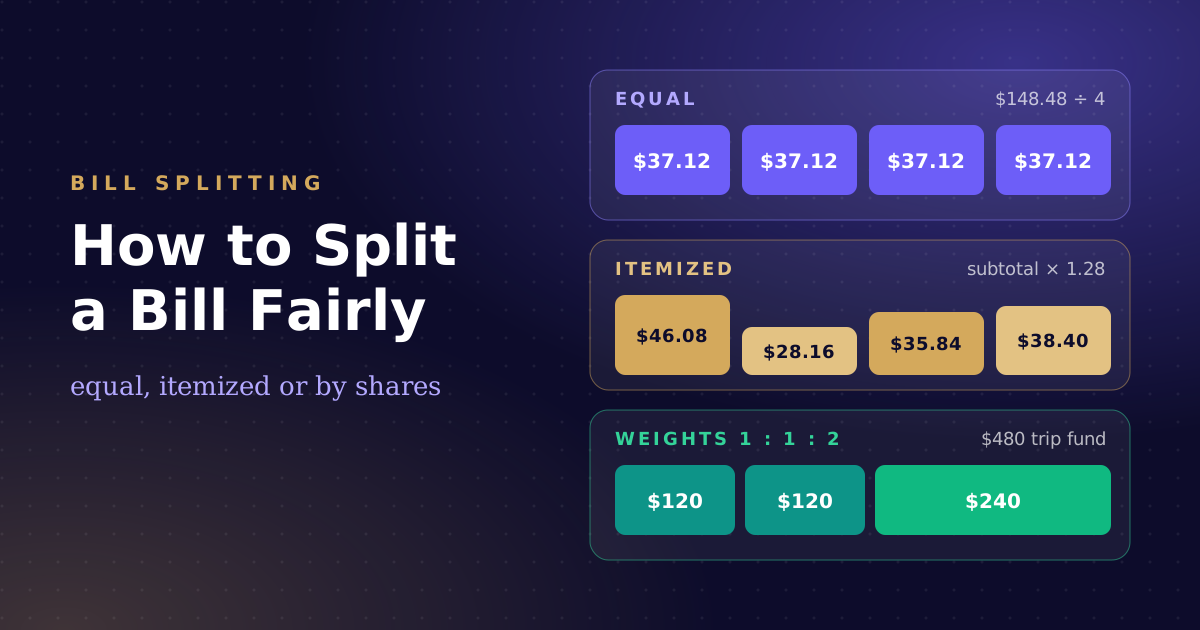
An even split is fast and works well when everyone ordered roughly the same. The trouble starts when the orders are far apart. If a table of four runs up a $200 bill and one person’s food and drinks came to $18, an even split charges them $50. They are covering about $32 of someone else’s dinner.
Itemizing fixes that. It takes a few extra minutes, but each person pays for what they ordered plus a fair piece of what was shared. This article assumes the group has already agreed to an itemized split.
The itemized workflow, step by step
Work through these steps in order. Each one depends on the one before it.
- Assign individual items. Go down the receipt and put each entree, side and personal drink next to the name of the person who ordered it.
- Identify shared items. Mark anything more than one person ate or drank: appetizers, a bottle of wine, a pitcher, a dessert with several spoons.
- Allocate shared items only to the people who shared them. If three of four people shared the calamari, it is split three ways, not four.
- Calculate each person’s subtotal. Individual items plus their piece of each shared item.
- Allocate tax. Multiply the bill’s tax by each person’s share of the subtotal.
- Allocate tip or service charge. Same proportional logic, using whichever base the tip was calculated on.
- Apply discounts using the logic you chose. Whole-bill discounts are shared proportionally; item discounts go to the person who ordered the item.
- Round only at the end. Keep fractions of a cent through every step, then round each final amount once.
- Verify the totals. The per-person amounts must add up to the exact amount on the receipt, to the cent.
The core formula for every proportional extra is:
Person’s share of an extra = Extra amount × (Person’s subtotal ÷ Table subtotal)
A shortcut that follows from this: when tax, tip and service charge are all calculated on the same subtotal, you can skip the separate lines and compute Person’s final amount = Bill total × (Person’s subtotal ÷ Table subtotal). The separate lines are still useful for showing people where their number came from.
Step 1: Assign individual items
Read the receipt line by line. For each line, write down who ordered it. Individual drinks belong here too: a cocktail, a glass of wine or a soda ordered by one person is theirs alone, even if the table shared the food. Drinks are often the biggest source of unfairness in an even split, because one person’s two cocktails can cost more than another person’s whole meal.
If the receipt lumps several identical items into one line (“2 × House Burger $36”), split that line into its parts before assigning.
Step 2 and 3: Identify shared items and who shared them
Shared appetizers, shared drinks such as a bottle or pitcher, and shared desserts go on a separate list with the names of the people who had some. The key rule is that a shared item is divided among its participants, not among the whole table. Someone who did not drink the wine should not pay for a slice of it.
Most groups split a shared item equally among the people who shared it. If portions were clearly different (one person ate eight of twelve dumplings), you can split by portions instead. The details, including platters, desserts and people who abstain, are covered in how to split shared items on a restaurant bill.
Step 4: Each person’s subtotal
Add each person’s individual items to their piece of every shared item they joined. Keep the fractions. If a $16 appetizer was split three ways, each piece is $5.3333…, not $5.33. Rounding here creates leftover pennies that someone will have to chase later.
Steps 5 and 6: Tax, tip and service charge
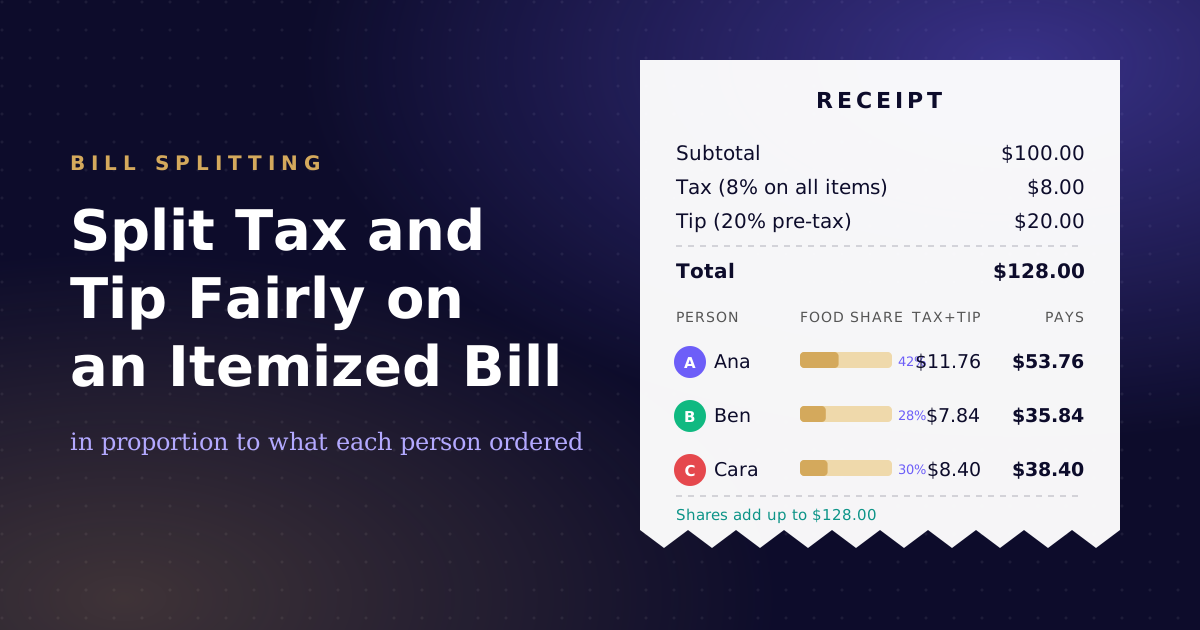
Tax and tip should follow the food. The person who ordered 40% of the subtotal pays 40% of the tax and 40% of the tip. Two things to check on the receipt first:
- What the tax applies to. Sales tax rules vary by state and city, and some places tax food and alcohol at different rates. The examples below each state an assumed rate.
- What the tip was calculated on. Some people tip on the pre-tax subtotal, others on the post-tax total. Neither is universal. Use whatever base the group actually tipped on.
A service charge is a fee the restaurant adds, often for larger parties. A tip is voluntary. If the bill already has a service charge, check whether the group also wants to add a tip on top. Do not count the same gratuity twice. Service charges are allocated with the same proportional formula as tax and tip.
For the full method, including mixed tax rates and tipping on discounted bills, see how to split tax and tip fairly on an itemized bill.
Step 7: Discounts
Before allocating a discount, name exactly what it applies to:
| Discount type | Example | How to allocate |
|---|---|---|
| Whole bill, fixed amount | $10 off the check | Proportional to each person’s subtotal |
| Whole bill, percentage | 15% off food | Proportional to each person’s subtotal of the discounted items |
| One item | Half-price bottle of wine | Only to the people who shared that item |
| One person | Birthday entree comped | Only to that person |
A related question is whether to tip on the pre-discount or post-discount amount. Many diners tip on the pre-discount amount because the server did the same work either way, but that is a group choice. Example 4 below shows it.
Steps 8 and 9: Round once, then check
Round each person’s final amount to the cent only after everything else is done. If the rounded amounts come to a cent more or less than the bill, adjust using a fixed rule: the person with the largest dropped fraction of a cent gets the extra cent, and ties go to the first name on the list. Then add the final column and compare it to the receipt. If the numbers do not match exactly, something was missed. Leftover cents have their own guide: how to handle rounding when splitting a bill.
Worked example 1: three people, one shared appetizer
Known values:
- Maya: pasta $22, glass of wine $12
- Jordan: burger $18, soda $4
- Sam: salad $14, iced tea $3
- Shared by all three: nachos $15
- Food and drink subtotal: $88.00
- Assume an 8% sales tax on all food and drink items: $7.04
- Tip: 20% on the pre-tax subtotal: $17.60
- Bill total: $112.64
Chosen method: itemized, shared appetizer split equally among all three, tax and tip proportional to subtotal.
Formula: Subtotal = Individual items + Shared pieces. Tax share = $7.04 × (Subtotal ÷ $88). Tip share = $17.60 × (Subtotal ÷ $88).
Calculation:
- Nachos: $15 ÷ 3 = $5.00 each
- Maya: $34 + $5 = $39.00, which is 39 ÷ 88 of the bill (about 44.3%)
- Jordan: $22 + $5 = $27.00, which is 27 ÷ 88 (about 30.7%)
- Sam: $17 + $5 = $22.00, which is 22 ÷ 88 (25%)
| Person | Individual Items | Shared Items | Tax | Tip | Final |
|---|---|---|---|---|---|
| Maya | $34.00 | $5.00 | $3.12 | $7.80 | $49.92 |
| Jordan | $22.00 | $5.00 | $2.16 | $5.40 | $34.56 |
| Sam | $17.00 | $5.00 | $1.76 | $4.40 | $28.16 |
| Total | $73.00 | $15.00 | $7.04 | $17.60 | $112.64 |
Rounded result: Maya $49.92, Jordan $34.56, Sam $28.16. Every number came out to whole cents, so no rounding adjustment was needed.
Total check: $49.92 + $34.56 + $28.16 = $112.64, which matches the bill.
Interpretation: An even split would have been $37.55 each. Sam would have overpaid by $9.39 and Maya underpaid by $12.37, mostly because of her glass of wine.
Worked example 2: four people, different shared items, one big order and one small one
This is the kind of table where an even split feels most unfair. Priya ordered a lot, Dana ordered very little, and different subsets of the group shared different things.
Known values:
- Priya: steak $38, two cocktails $28 (individual total $66)
- Ben: pasta $21
- Carlos: pizza $19, beer $8 (individual total $27)
- Dana: soup $9
- Calamari $16, shared by Priya, Ben and Carlos (Dana skipped it)
- Bottle of wine $36, shared by Ben and Carlos
- Dessert $10, shared by Ben and Dana
- Food and drink subtotal: $185.00
- Assume a 9% sales tax on all items: $16.65
- Tip: 18% on the pre-tax subtotal: $33.30
- Bill total: $234.95
Chosen method: itemized; each shared item split equally among only the people who had it; tax and tip proportional to subtotal.
Formula: Final = $234.95 × (Subtotal ÷ $185), because tax and tip are both calculated on the same $185 base.
Calculation of shared pieces:
- Calamari: $16 ÷ 3 = $5.3333… each for Priya, Ben and Carlos
- Wine: $36 ÷ 2 = $18.00 each for Ben and Carlos
- Dessert: $10 ÷ 2 = $5.00 each for Ben and Dana
Subtotals (kept unrounded):
- Priya: $66 + $5.3333 = $71.3333
- Ben: $21 + $5.3333 + $18 + $5 = $49.3333
- Carlos: $27 + $5.3333 + $18 = $50.3333
- Dana: $9 + $5 = $14.0000
- Check: $71.3333 + $49.3333 + $50.3333 + $14 = $185.00
| Person | Individual Items | Shared Items | Tax | Tip | Final |
|---|---|---|---|---|---|
| Priya | $66.00 | $5.33 | $6.42 | $12.84 | $90.60 |
| Ben | $21.00 | $28.33 | $4.44 | $8.88 | $62.65 |
| Carlos | $27.00 | $23.33 | $4.53 | $9.06 | $63.92 |
| Dana | $9.00 | $5.00 | $1.26 | $2.52 | $17.78 |
| Total | $123.00 | $62.00 | $16.65 | $33.30 | $234.95 |
The shared column shows rounded display values; the calculation used the exact thirds.
Rounded result: The unrounded finals were $90.5933, $62.6533, $63.9233 and $17.78. Rounding each down gives $234.94, one cent short. Priya, Ben and Carlos all dropped the same third of a cent, so the tie goes to the first name on the list, and Priya’s share becomes $90.60.
Total check: $90.60 + $62.65 + $63.92 + $17.78 = $234.95, which matches the bill.
Interpretation: An even split would be $58.74 each. Dana, who ordered a $9 soup and half a dessert, would have paid $40.96 more than her itemized share. Priya would have paid $31.86 less. This is the situation where itemizing matters most.
When one person ordered much more or much less
The two outliers in example 2 show the most common friction at a table.
One person ordered much more. Expensive entrees and personal drinks should be assigned to that person in step 1, and their larger subtotal automatically gives them a larger share of tax and tip. They do not need to “top up” anything extra. The proportional formula already handles it.
One person ordered much less. Keep them out of shared items they did not touch (Dana was left off the calamari and the wine). Their small subtotal then gives them a small share of tax and tip. If the group prefers a mostly even split, a common compromise is to split evenly among everyone except the light eater, who pays their itemized amount.
Worked example 3: a service charge instead of a tip
Some restaurants add an automatic service charge. Here there is no separate tip, because the group decided the service charge covered it.
Known values:
- Omar: $60 (entree and two drinks)
- Lena: $48
- Theo: $12 (a side salad)
- Subtotal: $120.00
- Assume a 6% sales tax on all items: $7.20
- Service charge: 18% of the pre-tax subtotal: $21.60
- No additional tip
- Bill total: $148.80
Chosen method: itemized; tax and service charge proportional to subtotal.
Formula: Final = $148.80 × (Subtotal ÷ $120).
Calculation: Omar’s share is 60 ÷ 120 = 50%, Lena’s is 40%, Theo’s is 10%.
| Person | Individual Items | Shared Items | Tax | Service charge | Final |
|---|---|---|---|---|---|
| Omar | $60.00 | $0.00 | $3.60 | $10.80 | $74.40 |
| Lena | $48.00 | $0.00 | $2.88 | $8.64 | $59.52 |
| Theo | $12.00 | $0.00 | $0.72 | $2.16 | $14.88 |
| Total | $120.00 | $0.00 | $7.20 | $21.60 | $148.80 |
Rounded result: Omar $74.40, Lena $59.52, Theo $14.88. No adjustment needed.
Total check: $74.40 + $59.52 + $14.88 = $148.80.
Interpretation: Treating the service charge as a flat per-head fee would have charged Theo $7.20 in service alone, more than half the price of his salad. The proportional version charges him $2.16. If the group had also added a tip on top of the service charge, that would be a separate, deliberate choice and should be allocated the same way.
Worked example 4: a whole-bill coupon
Take the table from example 1 again, but this time the group has a $10-off coupon for the whole check.
Known values:
- Same items as example 1: Maya $39, Jordan $27, Sam $22 (subtotal $88.00)
- Coupon: $10 off the whole bill, applied before tax
- Discounted subtotal: $78.00
- Assume the restaurant charges 8% sales tax on the discounted subtotal: $6.24 (some jurisdictions tax the pre-discount amount; check your receipt)
- Tip: the group chooses 20% of the pre-discount, pre-tax subtotal: $17.60
- Bill total: $78.00 + $6.24 + $17.60 = $101.84
Chosen method: the coupon, tax and tip are all shared in proportion to each person’s pre-discount subtotal.
Formula: Final = $101.84 × (Subtotal ÷ $88).
Calculation:
- Maya: $101.84 × 39 ÷ 88 = $45.1336
- Jordan: $101.84 × 27 ÷ 88 = $31.2464
- Sam: $101.84 × 22 ÷ 88 = $25.46
Rounded result: Maya $45.13, Jordan $31.25, Sam $25.46.
Total check: $45.13 + $31.25 + $25.46 = $101.84.
Interpretation: Each person’s coupon benefit is proportional to what they ordered: Maya saves about $4.43, Jordan about $3.07 and Sam $2.50 on the coupon itself. If the coupon had instead been “free dessert” for one person, only that person’s share would drop.
Common mistakes on uneven bills
- Splitting shared items across the whole table. Only the people who had the item should pay for it.
- Splitting tax and tip evenly on an itemized bill. It undoes much of the fairness of itemizing. Tax and tip should follow the subtotal.
- Rounding each line as you go. Five rounded lines per person can drift several cents from the receipt. Keep exact values until the end.
- Tipping on top of a service charge without deciding to. Read the receipt carefully before adding a tip.
- Skipping the final check. If the column does not add up to the bill, the person who paid ends up covering the gap.
Doing an itemized split in the Split Calculator
The Split Calculator splits each expense equally among the people you tick, works in exact cents and rounds once at the end so the shares always add up to the total. It has no separate tax, tip or discount fields, so here is how to enter an uneven restaurant bill honestly:
- Add everyone at the table as a person.
- Add each individual item (or each person’s combined individual items) as an expense, set who paid, and tick only the person who ordered it.
- Add each shared item as its own expense and tick only the people who shared it. The calamari in example 2 is one expense with Priya, Ben and Carlos ticked.
- For tax and tip, pick one of two options. For an equal split of the extras, add one “Tax and tip” expense and tick everyone. For the proportional split used in this article, work out each person’s tax and tip with the formula above and add one small expense per person, ticked only for them.
- Read the summary. It shows what each person owes and who pays whom, and you can copy it or share it on WhatsApp.
If the bill was simple and everyone agrees to split it evenly, you can skip the itemizing and just divide the bill between people in one step.