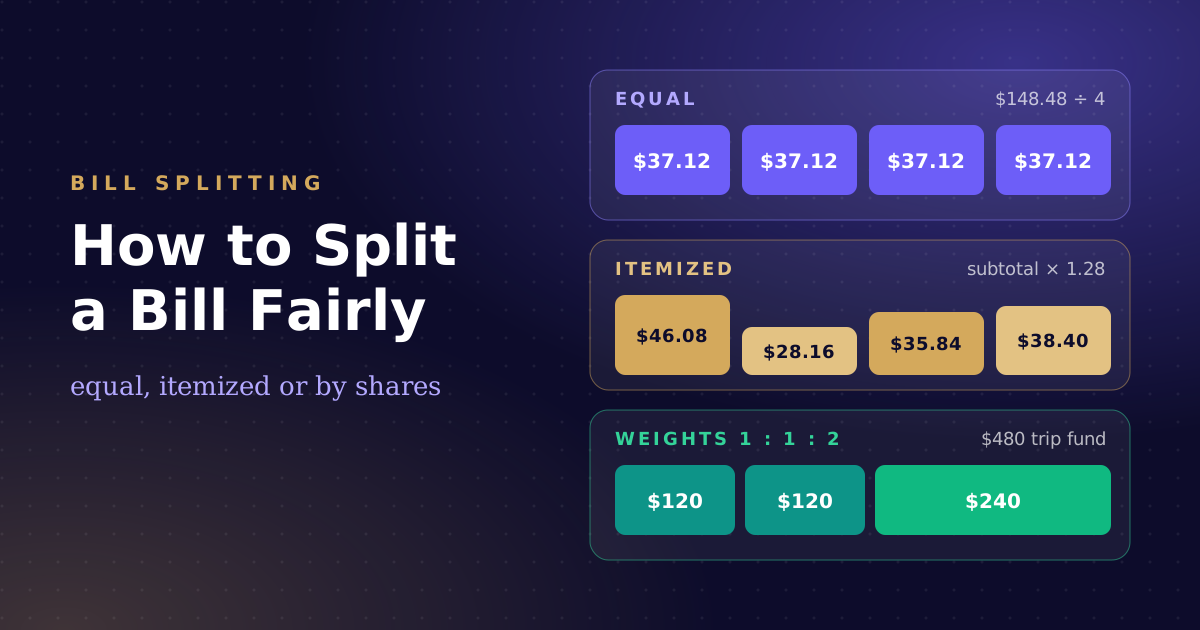
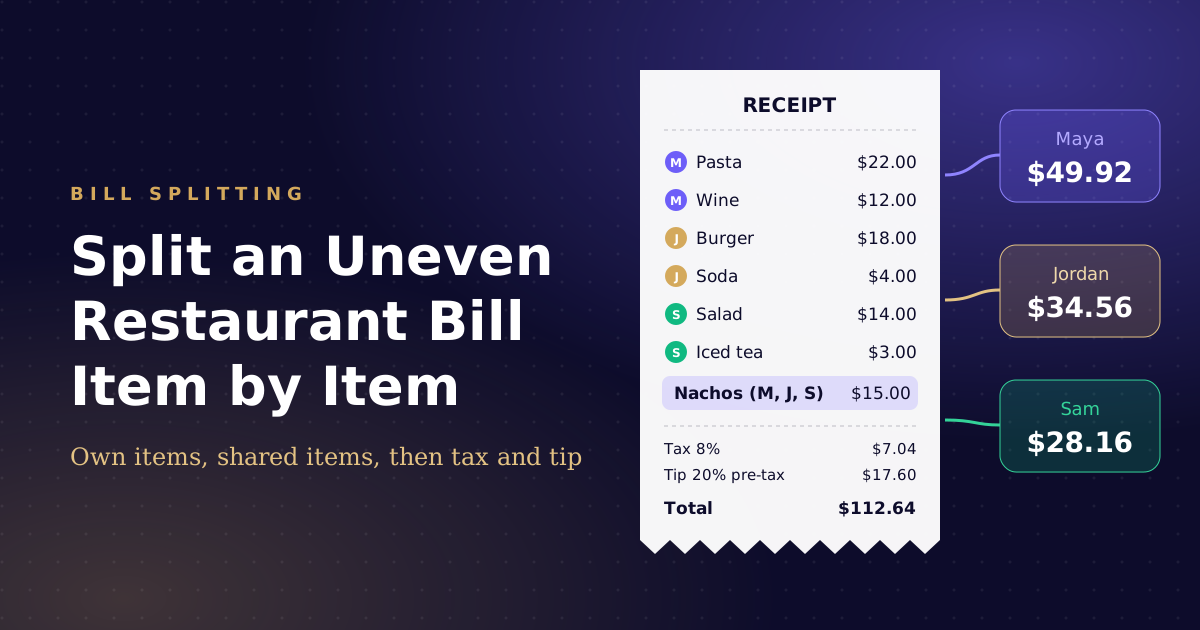
To split tax and tip fairly on an itemized bill, divide them in proportion to what each person ordered. First find each person’s share of the food and drink subtotal (their subtotal divided by the group subtotal). Then each person pays that same percentage of the tax and that same percentage of the tip. If your items were 30% of the subtotal, you cover 30% of the tax and 30% of the tip.
This works because sales tax and a percentage tip both scale with how much was ordered. The person who had a $12 salad should not pay the same tax and tip as the person who had a $55 steak and two cocktails. The rest of this guide covers the formulas, the choices you need to make before calculating (pre-tax or post-tax tip, untaxed items, service charges, discounts) and six worked examples.
The three numbers you need first
Before you touch tax or tip, get three values from the itemized receipt.
Individual subtotal. The price of everything one person ordered, before tax and tip. If items were shared, allocate them first; our guide to splitting shared items on a restaurant bill covers that step.
Group subtotal. The sum of all individual subtotals. It should match the subtotal line on the receipt. If it does not, an item is missing or counted twice. Fix that before going further.
Spending share. The fraction of the group subtotal that belongs to one person.
Person’s Spending Share = Individual Subtotal ÷ Group Subtotal
The spending shares of everyone at the table always add up to 1 (or 100%). That is a quick check that your subtotals are right.
The proportional tax and tip formulas
Once you have spending shares, tax and tip follow directly.
Person’s Tax Share = Total Tax × Spending Share
Person’s Tip Share = Total Tip × Spending Share
Person’s Total = Individual Subtotal + Tax Share + Tip Share
A table keeps it readable:
| Person | Subtotal | % of Food | Tax Share | Tip Share |
|---|---|---|---|---|
| Name | their items | subtotal ÷ group subtotal | tax × % | tip × % |
Two practical rules make this reliable:
- Use the tax and tip amounts the group actually pays. The receipt shows the tax in dollars and cents. Use that figure, not your own recalculation, because restaurants round tax and sometimes apply it differently than you expect.
- Round once, at the end. Keep the unrounded tax and tip shares, add them to each subtotal, then round each person’s final total to the cent. Rounding every intermediate number can leave you a few cents short or over.
Equal tip vs proportional tip
Some groups split the food by item but divide the tip equally, reasoning that everyone received the same service. That is a legitimate choice, and it is easy to agree on. The trade-off is that a percentage tip is calculated from the bill amount, so an equal split shifts part of the big spenders’ tip onto the light eaters.
| Approach | How the tip is divided | Works well when | Downside |
|---|---|---|---|
| Equal tip | Total tip ÷ number of people | Orders are similar in price, or the group sees tip as payment for shared service | Light eaters subsidize heavy spenders |
| Proportional tip | Total tip × spending share | Orders differ a lot in price | Needs a quick calculation per person |
Neither approach is wrong. What matters is agreeing before the math starts. Example 2 below shows how big the gap can get.
Tax basis caveats: what actually gets taxed
Sales tax on restaurant meals depends on where you are. States, counties and cities set their own rates, and they differ on what is taxable. Some places tax prepared food and drinks at one rate and alcohol at another. Some treat mandatory service charges as taxable and voluntary tips as not. Some exempt certain items, such as packaged goods sold to take home. Outside the US, prices often already include tax.
So there is no single tax formula that works everywhere. The proportional method still works, but you have to apply it to the right base:
- All items taxed at one rate: split the total tax by spending share, as above.
- Only some items taxed: split the tax only across the eligible items.
Tax Share = Individual Eligible Subtotal ÷ Total Eligible Subtotal × Total Tax
- Different rates for different items: split each tax line separately across the items it applies to, then add each person’s pieces together.
Every example below states its assumed tax model. Those models are illustrations, not statements about any specific jurisdiction’s law.
Pre-tax tip vs post-tax tip
A tip can be calculated on the pre-tax subtotal or the post-tax total. Many people tip on the pre-tax amount, since tax goes to the government, not the restaurant. Others tip on the final number because it is the one printed at the bottom. Both are common. The difference on a $100 subtotal with 8% tax and a 20% tip is $1.60.
For splitting, the choice only changes the size of the tip. Once the group settles on a tip amount, divide it with the same spending shares either way. Just decide which base you are using before anyone calculates, so every person is working from the same tip total.
Service charges and automatic gratuity
A service charge is a fee the restaurant adds to the bill. An automatic gratuity is a service charge described as a tip, often added for larger parties. Either way, it is printed on the receipt and it is not optional in the moment.
Three things to watch:
- Do not double-tip by accident. If the bill already includes an 18% or 20% gratuity, adding another 20% on top means tipping twice. Read the receipt line and look for words like “gratuity included” or “service charge”. Some venues use a service charge for other costs, so if you are unsure whether it goes to staff, ask.
- Split it like a tip. A percentage service charge scales with the food, so dividing it by spending share is consistent with how it was calculated.
- Check whether it was taxed. In some places the service charge is taxed, in others it is not. You do not need to know the rule; just use the tax figure on the receipt and split it across whatever it was charged on.
If the group wants to add a little extra for great service on top of an included gratuity, treat that extra as a separate voluntary tip and agree on how to divide it.
Discounts: before or after the tip?
Discounts change the numbers in two places: the subtotal and, possibly, the tip base. Be specific about what the discount applies to.
- Whole-bill percentage discount (for example 20% off all food): reduce every person’s subtotal by the same percentage. Spending shares stay the same.
- Whole-bill fixed discount (for example $15 off the check): allocate it in proportion to subtotals, or equally if the group prefers. Say which.
- One item or one person (for example a free birthday dessert): reduce only that person’s subtotal. Everyone’s spending share changes a little.
For the tip, many diners tip on the pre-discount amount, since the server did the same work regardless of the coupon. Others tip on the post-discount amount. Again, pick one. For tax, whether it applies to the discounted price depends on the jurisdiction and the type of discount; use the tax on the receipt.
Worked examples
Each example states the tax model, the tip base and the method. All totals were checked so the rounded shares add up to the exact bill.
Example 1: Basic proportional split
Known values: Ana ordered $42, Ben $28 and Cara $30. Group subtotal $100.00. Assume an 8% sales tax on all food and drink, so tax is $8.00. Tip is 20% of the pre-tax subtotal, so $20.00. Bill total $128.00.
Chosen method: Proportional tax and proportional tip.
Formula: Spending share = subtotal ÷ $100. Tax share = $8.00 × share. Tip share = $20.00 × share.
| Person | Subtotal | % of Food | Tax Share | Tip Share | Total |
|---|---|---|---|---|---|
| Ana | $42.00 | 42% | $3.36 | $8.40 | $53.76 |
| Ben | $28.00 | 28% | $2.24 | $5.60 | $35.84 |
| Cara | $30.00 | 30% | $2.40 | $6.00 | $38.40 |
| Total | $100.00 | 100% | $8.00 | $20.00 | $128.00 |
Total check: $53.76 + $35.84 + $38.40 = $128.00. Difference $0.00.
Interpretation: Everyone pays tax and tip at the same effective rate (28% on top of their food), which is exactly what the receipt charged the table.
Example 2: Equal tip vs proportional tip on uneven orders
Known values: Four friends. Dev had a salad and water for $18, Eli $46, Fay $39 and Gus $57. Group subtotal $160.00. Assume an 8% sales tax on all items: $12.80. Tip is 20% of the pre-tax subtotal: $32.00. Bill total $204.80.
Chosen method: Tax is proportional in both versions. The tip is compared two ways: equal ($8.00 each) and proportional.
Formula: Tax share = $12.80 × share. Equal tip = $32.00 ÷ 4. Proportional tip = $32.00 × share.
| Person | Subtotal | % of Food | Tax Share | Proportional Tip | Total (proportional tip) | Total (equal tip) |
|---|---|---|---|---|---|---|
| Dev | $18.00 | 11.25% | $1.44 | $3.60 | $23.04 | $27.44 |
| Eli | $46.00 | 28.75% | $3.68 | $9.20 | $58.88 | $57.68 |
| Fay | $39.00 | 24.375% | $3.12 | $7.80 | $49.92 | $50.12 |
| Gus | $57.00 | 35.625% | $4.56 | $11.40 | $72.96 | $69.56 |
| Total | $160.00 | 100% | $12.80 | $32.00 | $204.80 | $204.80 |
Total check: Both columns sum to $204.80. Difference $0.00.
Interpretation: With an equal tip, Dev pays $4.40 more and Gus pays $3.40 less than under the proportional method. On a single dinner that may not matter to your group. If the same people eat together every week, it adds up, which is usually when people switch to proportional tips.
Example 3: Some items are not taxed
Known values: Ana ordered $40 of food, Cara $35. Ben ordered $30 of food and also bought a $25 bag of retail coffee beans to take home. Assume, for this example, that an 8% tax applies to the dining items but the packaged beans are untaxed. Eligible subtotal is $105.00 and the receipt shows $8.40 tax. The group tips 18% on the dining items only: $18.90. Bill total $130.00 + $8.40 + $18.90 = $157.30.
Chosen method: Tax split by eligible subtotal. Tip split by dining subtotal. Ben’s beans are added to his total with no tax or tip.
Formula: Tax share = eligible subtotal ÷ $105 × $8.40. Tip share = dining subtotal ÷ $105 × $18.90.
| Person | Full Subtotal | Eligible Subtotal | % of Eligible | Tax Share | Tip Share | Total |
|---|---|---|---|---|---|---|
| Ana | $40.00 | $40.00 | 38.10% | $3.20 | $7.20 | $50.40 |
| Ben | $55.00 | $30.00 | 28.57% | $2.40 | $5.40 | $62.80 |
| Cara | $35.00 | $35.00 | 33.33% | $2.80 | $6.30 | $44.10 |
| Total | $130.00 | $105.00 | 100% | $8.40 | $18.90 | $157.30 |
Total check: $50.40 + $62.80 + $44.10 = $157.30. Difference $0.00.
Interpretation: If you had split tax by the full subtotal, Ben’s share would have been $8.40 × 55 ÷ 130, about $3.55, instead of $2.40. He would have paid tax on beans that were never taxed. Splitting on the eligible base fixes that.
Example 4: Post-tax tip with rounding at the end
Known values: Priya ordered $31.50, Sam $22.75 and Tom $41.25. Group subtotal $95.50. Assume an 8.875% tax on all items; the receipt shows $8.48. The group tips 20% on the post-tax total: 20% of $103.98 is $20.796, rounded to a $20.80 tip. Bill total $124.78.
Chosen method: Proportional tax and tip, using full precision until the last step.
Formula: Person’s total = subtotal + ($8.48 + $20.80) × share.
| Person | Subtotal | % of Food | Tax Share (unrounded) | Tip Share (unrounded) | Exact Total | Rounded |
|---|---|---|---|---|---|---|
| Priya | $31.50 | 32.98% | $2.7971 | $6.8607 | $41.1578 | $41.16 |
| Sam | $22.75 | 23.82% | $2.0201 | $4.9550 | $29.7251 | $29.72 |
| Tom | $41.25 | 43.19% | $3.6628 | $8.9843 | $53.8971 | $53.90 |
| Total | $95.50 | 100% | $8.48 | $20.80 | $124.78 | $124.78 |
Total check: $41.16 + $29.72 + $53.90 = $124.78. Difference $0.00.
Interpretation: Here the rounded totals happen to land exactly on the bill. That will not always be true. When three or more people split a bill, rounding each total can leave the sum a cent or two off. The fix is to round down, then hand the leftover cents to the people with the largest remainders. Our guide to handling rounding when splitting a bill walks through that method.
Example 5: Automatic gratuity on a larger party
Known values: A party of four. Subtotals: Alex $72, Bea $54, Chris $66, Dana $48. Group subtotal $240.00. The restaurant adds an 18% automatic gratuity on the pre-tax subtotal: $43.20. Assume a 7% tax on food and drink and that, in this example, the service charge is not taxed: $16.80. Bill total $300.00.
Chosen method: Proportional tax and proportional gratuity. No extra tip.
Formula: Tax share = $16.80 × share. Gratuity share = $43.20 × share.
| Person | Subtotal | % of Food | Tax Share | Gratuity Share | Total |
|---|---|---|---|---|---|
| Alex | $72.00 | 30.0% | $5.04 | $12.96 | $90.00 |
| Bea | $54.00 | 22.5% | $3.78 | $9.72 | $67.50 |
| Chris | $66.00 | 27.5% | $4.62 | $11.88 | $82.50 |
| Dana | $48.00 | 20.0% | $3.36 | $8.64 | $60.00 |
| Total | $240.00 | 100% | $16.80 | $43.20 | $300.00 |
Total check: $90.00 + $67.50 + $82.50 + $60.00 = $300.00. Difference $0.00.
Interpretation: The gratuity is already the tip. If someone had added a 20% tip to the $300 total without reading the receipt, the table would have paid $60.00 more, on top of the $43.20 already charged.
Example 6: A coupon, with the tip on the pre-discount amount
Known values: Lena ordered $50, Max $30 and Nora $40, for a $120.00 subtotal. A 20% off coupon applies to the whole food bill, so the discount is $24.00 and the discounted subtotal is $96.00. Assume an 8% tax charged on the discounted amount: $7.68. The group tips 20% on the pre-discount subtotal: $24.00. Bill total $96.00 + $7.68 + $24.00 = $127.68.
Chosen method: Discount allocated proportionally (each subtotal drops 20%). Tax split by discounted subtotal. Tip split by pre-discount subtotal. Because the discount is a flat percentage, both give the same spending shares.
Formula: Discounted subtotal = subtotal × 0.8. Tax share = $7.68 × share. Tip share = $24.00 × share.
| Person | Original Subtotal | After Coupon | % of Food | Tax Share | Tip Share | Total |
|---|---|---|---|---|---|---|
| Lena | $50.00 | $40.00 | 41.67% | $3.20 | $10.00 | $53.20 |
| Max | $30.00 | $24.00 | 25.00% | $1.92 | $6.00 | $31.92 |
| Nora | $40.00 | $32.00 | 33.33% | $2.56 | $8.00 | $42.56 |
| Total | $120.00 | $96.00 | 100% | $7.68 | $24.00 | $127.68 |
Total check: $53.20 + $31.92 + $42.56 = $127.68. Difference $0.00.
Interpretation: Tipping on the pre-discount amount adds $4.80 compared with tipping on $96. If the coupon had instead covered only Max’s entree, only Max’s subtotal would drop, and every spending share would shift slightly before you split tax and tip.
Step-by-step checklist
- Assign every item on the receipt to a person. Split shared plates first.
- Add each person’s items to get their individual subtotal. Confirm the subtotals add up to the receipt subtotal.
- Apply any discount to the subtotals it covers.
- Decide the tip base (pre-tax or post-tax, pre-discount or post-discount) and whether the tip is split equally or proportionally. Check for an included gratuity.
- Find each person’s spending share. If only some items are taxed, find eligible shares for the tax.
- Multiply the tax and the tip by the shares.
- Add subtotal, tax share and tip share for each person, then round once.
- Check that the rounded totals equal the bill total exactly. Adjust leftover cents with a fixed rule.
If you want the full restaurant workflow, from reading the receipt to collecting payments, see how to split a restaurant bill unevenly.
Using the Split Calculator with tax and tip
The Split Calculator does not have tax, tip or service charge fields. It splits each expense equally among the people you tick, works in exact cents and makes sure the shares add up to the total. You can still use it for tax and tip in two honest ways:
- Equal tip, itemized food: enter each dish as its own expense, ticked for whoever ate it, and add the tax and tip as one more expense ticked for everyone. That gives you an itemized food split with tax and tip divided equally.
- Proportional tax and tip: work out each person’s total with the formulas above, then enter each person’s amount as a separate expense ticked only for that person, with the actual payer marked as having paid. The calculator then shows who owes the payer how much.
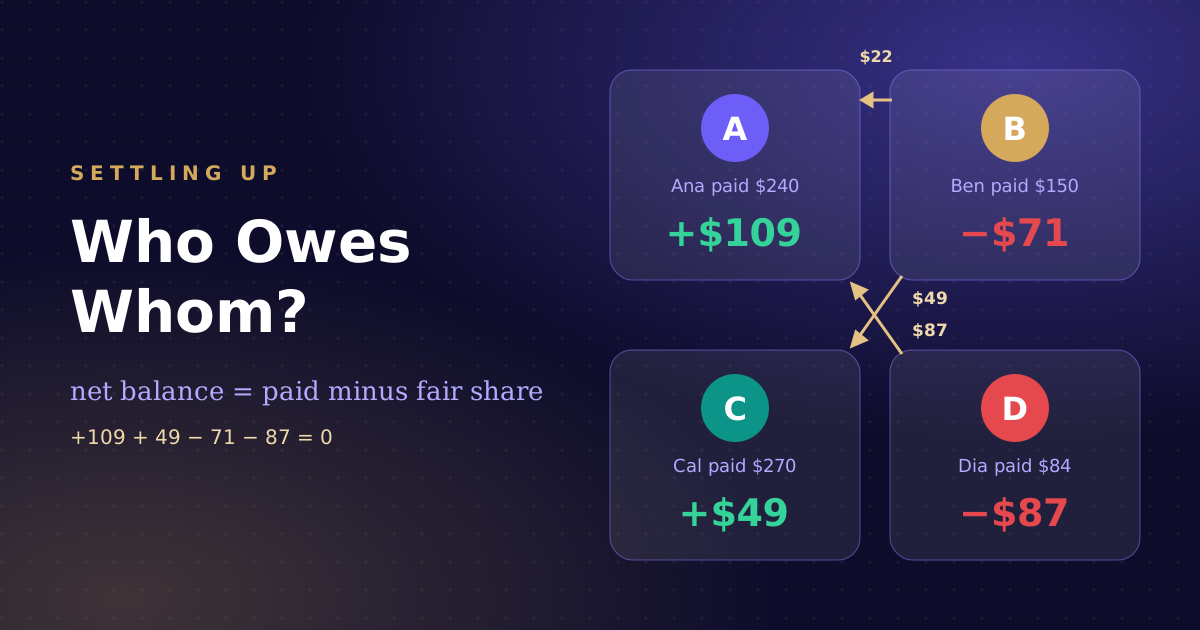
The second route takes a minute more, but it lets you calculate each person’s share with proportional tax and tip and still get a clean “who pays whom” list at the end.