Couples usually split expenses in one of five ways: 50/50, proportional to income, by assigning each partner specific bills, through a joint account that both fund, or with a hybrid of these. A 50/50 split gives each partner the same dollar cost. A proportional split gives each partner the same percentage of their income, using Income Share = Individual Net Income ÷ Combined Net Income. Neither is automatically right; the method that works is the one both partners understand, agree to and revisit when life changes.
This guide explains each method with a formula, shows worked examples that add up to the cent, and covers the details that cause friction later: what counts as income, which costs are shared, and how to handle a raise or pay cut.
The five main ways couples split expenses
| Method | How it works | Tends to suit | Main drawback |
|---|---|---|---|
| 50/50 | Every shared cost is divided equally | Similar incomes, newer relationships | Heavier on the lower earner when incomes differ |
| Proportional to income | Each pays their share of combined income | Couples with an income gap | Requires sharing pay details and recalculating |
| Fixed bill assignment | Each partner owns certain bills | Couples who dislike tracking | Bill totals drift away from the intended ratio |
| Shared account | Both deposit into a joint account that pays shared bills | Couples with many recurring bills | Needs a contribution formula and a buffer |
| Hybrid | Different methods for different categories | Couples with mixed priorities | More rules to remember |
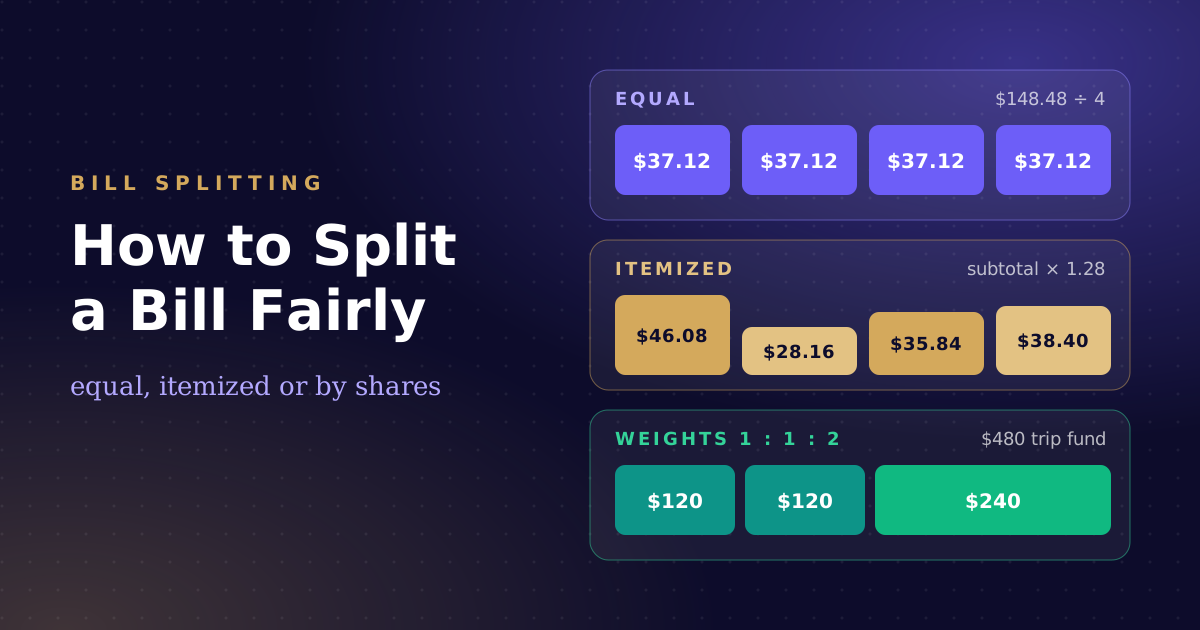
These are not competing philosophies so much as different answers to one question: what does “fair” mean in your household? Equal dollars, equal effort, or equal leftover money? If you want a broader look at how equal, itemized, percentage and share-based splits compare outside a relationship, see how to split a bill fairly.
Method 1: The 50/50 split
Each partner’s share = Shared expense ÷ 2
A 50/50 split is the easiest system to run. Every shared bill is halved, nobody needs to disclose a salary, and the math is instant. It works well when both partners earn roughly the same amount, when spending habits are similar, or when a relationship is new and finances are still mostly separate.
The trouble starts when incomes differ. The same dollar amount is a larger share of a smaller paycheck, so the lower earner has less left for savings and personal spending. Over years, that gap compounds. Some couples are fine with that trade-off because they value simplicity and independence; others find it quietly builds resentment.
Worked example 1: 50/50 vs proportional with a 60/40 income gap
- Known values: Partner A takes home $6,000 a month. Partner B takes home $4,000. Shared monthly expenses (rent, utilities, groceries, insurance) total $3,000.
- Chosen methods: Compare 50/50 with proportional to income.
- Formula (50/50): Share = $3,000 ÷ 2.
- Formula (proportional): Income Share = Individual Net Income ÷ Combined Net Income; Expense Share = $3,000 × Income Share.
- Calculation: Combined income is $6,000 + $4,000 = $10,000. A’s income share is $6,000 ÷ $10,000 = 60%. B’s is $4,000 ÷ $10,000 = 40%. Proportional: A pays $3,000 × 60% = $1,800, B pays $3,000 × 40% = $1,200. 50/50: each pays $1,500.
- Rounded result: No rounding needed in either case.
- Total check: $1,800 + $1,200 = $3,000. $1,500 + $1,500 = $3,000.
| 50/50 | Proportional | |
|---|---|---|
| A pays | $1,500 (25% of income) | $1,800 (30% of income) |
| B pays | $1,500 (37.5% of income) | $1,200 (30% of income) |
| A has left | $4,500 | $4,200 |
| B has left | $2,500 | $2,800 |
- Interpretation: Under 50/50, B spends 37.5% of take-home pay on shared costs while A spends 25%. Under the proportional split, both spend exactly 30%. Neither result is “wrong”. The table just makes the trade-off visible so you can choose on purpose.
Method 2: Proportional to income
Income Share = Individual Net Income ÷ Combined Net Income
Expense Share = Shared Expense × Income Share
A proportional split asks each partner to contribute the same percentage of their income, not the same number of dollars. In example 1, that percentage was 30% for both. The higher earner pays more in dollars, but the burden relative to pay is identical.
This method appeals to couples who see the household as a shared project and want both partners to have a similar cushion for saving and personal spending. It also scales naturally: if one partner’s income drops, their share drops with it.
Agree on what “net income” means
Before calculating anything, agree on the income figure. There is no single correct definition, and the choice changes the percentages. Questions to settle together:
- Gross or take-home pay? Take-home pay reflects what each person can actually spend. Gross pay is simpler to compare and does not change with payroll choices.
- Retirement contributions: If one partner puts 15% into a workplace plan and the other puts in 3%, the first partner’s take-home pay looks smaller. Some couples add retirement contributions back before calculating.
- Health insurance and other deductions: If one partner’s paycheck covers the family health plan, that deduction is already a shared expense. Adding it back avoids counting it twice.
- Irregular income: Bonuses, commissions, freelance income and side gigs vary. Many couples use a 12-month average or leave bonuses out of the formula and decide separately what to do with them.
- Student loans and existing debts: Some couples subtract required debt payments from income before splitting; others treat debts as personal. Either choice is reasonable if both agree.
Write the definition down. The formula is simple; the arguments usually come from each partner silently using a different income number.
Worked example 2: Uneven percentages that need rounding
- Known values: Partner A takes home $5,200 a month. Partner B takes home $3,100. Shared expenses are $2,750.
- Chosen method: Proportional to income, rounding only the final dollar amounts.
- Formula: Expense Share = $2,750 × Individual Income ÷ $8,300.
- Calculation: Combined income is $5,200 + $3,100 = $8,300. A’s share is $5,200 ÷ $8,300 = 62.6506…%. B’s share is $3,100 ÷ $8,300 = 37.3494…%. A: $2,750 × 5,200 ÷ 8,300 = $1,722.8916… B: $2,750 × 3,100 ÷ 8,300 = $1,027.1084…
- Rounded result: A pays $1,722.89, B pays $1,027.11.
- Total check: $1,722.89 + $1,027.11 = $2,750.00.
- Interpretation: Keep the unrounded fraction in the calculation and round only the dollar amounts at the end. If you round the percentages first to 63% and 37%, A would pay $1,732.50 and B $1,017.50, which shifts $9.61 a month (about $115 a year) toward A. That may be fine as an agreed simplification, but it should be a choice, not an accident.
Method 3: Fixed bill assignment
Instead of splitting each bill, each partner takes ownership of specific bills. One pays the rent or mortgage; the other covers utilities, groceries, internet and insurance. Nobody transfers money back and forth, and each partner pays their bills from their own account.
This is popular because it removes day-to-day tracking. The weakness is drift: bills change size, and the split you intended at the start slowly becomes something else. A quick check every few months compares what each partner actually pays against the ratio you wanted.
Worked example 3: Checking assigned bills against a 55/45 target
- Known values: Partner A takes home $5,500 and Partner B $4,500, so combined income is $10,000. A pays rent of $2,100. B pays utilities ($180), groceries ($650), internet ($70) and car insurance ($150), which is $1,050. Total shared costs: $3,150.
- Chosen method: Fixed bill assignment, with a balancing transfer to hit a proportional target.
- Formula: Target = $3,150 × Income Share. Balancing transfer = Amount actually paid minus target.
- Calculation: A’s income share is $5,500 ÷ $10,000 = 55%, so A’s target is $3,150 × 55% = $1,732.50. B’s target is $3,150 × 45% = $1,417.50. A actually pays $2,100, which is $2,100 minus $1,732.50 = $367.50 above target. B actually pays $1,050, which is $367.50 below target.
- Rounded result: B transfers $367.50 a month to A.
- Total check: A’s net cost $2,100 minus $367.50 = $1,732.50. B’s net cost $1,050 + $367.50 = $1,417.50. $1,732.50 + $1,417.50 = $3,150.00.
- Interpretation: Assigning bills alone gave A about 67% of shared costs, well above the 55% they intended. One monthly transfer fixes it. Alternatively, move a bill from A to B so the totals land closer to the target without any transfer.
Method 4: The shared account method
Both partners deposit money into a joint checking account, and every shared bill is paid from it. Personal spending stays in each partner’s own account. The deposit can be 50/50, proportional, or any other agreed ratio.
Two details make this work smoothly:
- Budget the shared bills first. Add up recurring shared costs and add a small buffer for price changes and irregular bills.
- Pick the contribution formula. Proportional contributions are common, and they can be stated two ways that give identical results: “each partner pays their income share of the budget” or “each partner deposits the same percentage of their income”.
Worked example 4: Funding a joint account proportionally
- Known values: Partner A takes home $7,500 and Partner B $2,500, so combined income is $10,000. Shared bills average $4,200 a month. The couple adds a $200 buffer, for a monthly target of $4,400.
- Chosen method: Proportional deposits into a joint account.
- Formula: Deposit = $4,400 × Individual Income ÷ Combined Income.
- Calculation: A’s share is $7,500 ÷ $10,000 = 75%, so A deposits $4,400 × 75% = $3,300. B’s share is 25%, so B deposits $4,400 × 25% = $1,100. As a percentage of income: $3,300 ÷ $7,500 = 44% and $1,100 ÷ $2,500 = 44%.
- Rounded result: A deposits $3,300, B deposits $1,100 each month.
- Total check: $3,300 + $1,100 = $4,400.
- Interpretation: “Each of us puts in 44% of take-home pay” and “we split the budget 75/25” are the same rule. Some couples find the percentage phrasing easier to talk about. If the buffer builds up, the couple can lower deposits, move the surplus to savings, or use it for a shared goal.
Method 5: Hybrid approaches
A hybrid uses different rules for different kinds of spending. A common version splits essentials proportionally, because they are non-negotiable, and splits discretionary costs 50/50, because both partners choose them together. Other versions reverse this, or split everything proportionally except one partner’s expensive hobby.
Worked example 5: Proportional essentials, 50/50 fun money
- Known values: Partner A takes home $4,900 and Partner B $3,500, so combined income is $8,400. Housing and utilities total $2,400 a month. Dining out and entertainment total $500.
- Chosen method: Essentials split proportionally; dining and entertainment split 50/50.
- Formula: Essentials share = $2,400 × Individual Income ÷ $8,400. Fun share = $500 ÷ 2.
- Calculation: A’s income share is $4,900 ÷ $8,400 = 58.333…%, so A’s essentials share is $2,400 × 4,900 ÷ 8,400 = $1,400. B’s is $2,400 × 3,500 ÷ 8,400 = $1,000. Fun: $500 ÷ 2 = $250 each.
- Rounded result: A pays $1,400 + $250 = $1,650. B pays $1,000 + $250 = $1,250.
- Total check: $1,650 + $1,250 = $2,900, which equals $2,400 + $500.
- Interpretation: The percentages look awkward (58.33% and 41.67%), but the dollar amounts come out round because the calculation keeps the full fraction until the end. The hybrid lets the couple share essentials by ability to pay while keeping the fun category simple.
Shared vs personal expenses
Every method depends on agreeing which costs are shared. Disagreements here cause more friction than the choice between 50/50 and proportional. A starting list many couples use:
| Usually shared | Often debated | Usually personal |
|---|---|---|
| Rent or mortgage | Car payments and gas | Clothing and personal care |
| Utilities and internet | Phone plans | Hobbies and subscriptions only one uses |
| Groceries and household supplies | Pet costs (if the pet came with one partner) | Individual debts from before the relationship |
| Home and renters insurance | Gifts for each other’s families | Personal travel |
| Shared subscriptions | Gym memberships | Personal savings goals |
| Childcare and kids’ costs | Dining out alone vs together | Solo meals out |
The “often debated” column has no universal answer. A car used for both partners’ errands may be shared; a car only one partner drives to work may not be. Pick a rule per item and write it down.
When incomes change: a review cadence
Proportional splits need maintenance because the inputs move. A simple routine:
- Annually: Recalculate income shares once a year, for example when tax documents arrive or at the start of a lease.
- At trigger events: Recalculate right away after a raise, job change, job loss, parental leave, a move, or a large new recurring bill.
- Temporary changes: For a short income dip, agree whether to recalculate or have the higher earner cover the gap for a set period, then return to the normal split.
Worked example 6: Recalculating after a raise
- Known values: Starting from example 1 (A $6,000, B $4,000, shared costs $3,000), Partner B gets a raise to $5,000 take-home. Shared costs stay at $3,000.
- Chosen method: Proportional to income, recalculated.
- Formula: Expense Share = $3,000 × Individual Income ÷ Combined Income.
- Calculation: Combined income is now $6,000 + $5,000 = $11,000. A’s share is $6,000 ÷ $11,000 = 54.5454…%. B’s share is $5,000 ÷ $11,000 = 45.4545…%. A: $3,000 × 6,000 ÷ 11,000 = $1,636.3636… B: $3,000 × 5,000 ÷ 11,000 = $1,363.6363…
- Rounded result: A pays $1,636.36, B pays $1,363.64.
- Total check: $1,636.36 + $1,363.64 = $3,000.00.
- Interpretation: B’s contribution rises by $163.64 a month and A’s falls by the same amount. Skipping the update means A keeps paying about $1,964 a year more than the agreed formula says.
Example percentages at a glance
These splits apply the proportional formula to a $3,000 monthly shared budget. Use them to get a quick sense of the numbers before calculating your own.
| Income ratio (A : B) | A’s share | B’s share | A pays | B pays |
|---|---|---|---|---|
| 50 : 50 | 50% | 50% | $1,500 | $1,500 |
| 55 : 45 | 55% | 45% | $1,650 | $1,350 |
| 60 : 40 | 60% | 40% | $1,800 | $1,200 |
| 65 : 35 | 65% | 35% | $1,950 | $1,050 |
| 70 : 30 | 70% | 30% | $2,100 | $900 |
| 75 : 25 | 75% | 25% | $2,250 | $750 |
| 80 : 20 | 80% | 20% | $2,400 | $600 |
How to choose a method together
There is no universal answer, but a few questions narrow it down quickly:
- How far apart are your incomes? If they are within a few percent, 50/50 and proportional give nearly the same result, so simplicity may win.
- How much tracking will you tolerate? Fixed bill assignment and joint accounts need the least day-to-day effort. Splitting each purchase needs the most.
- What does fair feel like to each of you? Equal dollars, equal percentage of income, or equal leftover money are all defensible. Say it out loud.
- How are big future costs handled? Children, a home purchase or one partner going back to school can change the answer, so agree on when you will revisit it.
This article is educational, not financial advice. Couples with complex situations, such as significant assets, business income or blended families, may want to talk with a qualified professional.
Using the Split Calculator for couple expenses
The Split Calculator divides each expense equally among the people who share it, so it fits the 50/50 method directly. Add both partners, enter each shared purchase with who paid, and tick both names. At the end of the month, it shows each partner’s paid amount, fair share and net balance, plus the single payment that settles up.
The calculator has no percentage field, so for a proportional split, work out each partner’s dollar amount with the income-share formula above and use those amounts for transfers or joint-account deposits. For a hybrid, you can still split the 50/50 categories in the calculator and handle the proportional categories with the formula. If you are also comparing itemized or share-based splits for other situations, the bill-splitting methods guide covers when each one fits.