To split Airbnb costs fairly, first agree on what you are dividing (the full booking total, including cleaning and service fees), then pick one rule: equal per person, per bedroom, or by person-nights with optional room weights. If everyone stays the whole time in similar rooms, divide the total by the number of guests. If rooms differ, couples share a room, or people arrive and leave on different days, a weighted or person-night split is easier to defend.
The fastest way to avoid an argument is to settle the method before anyone books, when nobody knows yet who gets the master suite. Below are the formulas, how to treat each fee, and five worked examples where every share adds back to the exact booking total.
Start with the numbers on your booking
Before choosing a method, write down each line from the booking confirmation, because different lines can be split differently:
- Nightly subtotal: the nightly rate times the number of nights.
- Cleaning fee: a one-time charge per stay, set by the host.
- Service fee: the platform’s fee on the booking.
- Taxes: occupancy or lodging taxes, which depend on the location.
- Security deposit: sometimes held or charged, refundable if nothing is damaged.
Fee structures and percentages vary by listing, location and platform, and they change over time, so do not estimate them. Use the exact amounts shown on your booking. If the host offered a weekly discount, the discounted nightly subtotal is what you split.
Fixed costs vs variable costs
This distinction settles most disputes about uneven stays.
| Cost | Type | Why | Common way to split |
|---|---|---|---|
| Nightly subtotal | Variable | Grows with each night booked | Per person, per room, or per person-night |
| Taxes on the stay | Variable | Usually charged on the nightly amount | Same rule as the nightly subtotal |
| Service fee | Usually variable | Tied to the size of the booking | Same rule as the nightly subtotal |
| Cleaning fee | Fixed | Charged once, however long anyone stays | Equal among everyone who stayed |
| Security deposit | Not a cost | Refunded unless something is kept | Only split the amount withheld |
Fixed costs do not care who stayed one night or four, so many groups split them equally among all guests. Variable costs scale with nights, so they follow whatever rule the group chose for nights and rooms. Neither choice is required; it is simply the most common reading of “pay for what you used.”
Method 1: Equal split per person
Divide the full booking total by the number of guests. It works well when bedrooms are similar, nobody is on a couch, and everyone stays the full trip.
Share = Booking total ÷ Number of guests
Worked example 1: six friends, same rooms, full stay
Known values: Booking total of $2,147.50 (nightly subtotal, cleaning fee, service fee and taxes as shown on the booking). Six guests, all staying every night in comparable rooms.
Chosen method: Equal per person.
Calculation: $2,147.50 ÷ 6 = $357.9166…
Rounded result: Working in cents, 214,750 ÷ 6 is 35,791 cents with 4 cents left over. Four guests pay $357.92 and two pay $357.91.
Total check: 4 × $357.92 + 2 × $357.91 = $1,431.68 + $715.82 = $2,147.50.
Interpretation: Nobody should pay $357.92 six times, because that collects 2 cents too much. Decide in advance who absorbs the extra cents, for example the first four names alphabetically. The Split Calculator does this automatically with the largest-remainder method.
Method 2: Split per bedroom
Divide the booking by the number of bedrooms, then each room’s occupants split that room’s share. This mirrors booking separate hotel rooms.
Room share = Booking total ÷ Number of bedrooms Person share = Room share ÷ People in that room
It is simple, but it can make a single person in a room pay double what each member of a couple pays, even though everyone uses the kitchen, pool and living room equally.
Couples: per person vs per room
This is the most common Airbnb argument. A couple takes one bedroom, so should they pay two shares or one? Both answers are defensible, and a hybrid often feels fairest.
Worked example 2: two couples and one single guest
Known values: Three-bedroom rental, $1,500 total. Maya and Leo share Bedroom 1. Priya and Sam share Bedroom 2. Jordan is alone in Bedroom 3. All rooms are similar; everyone stays every night.
Chosen methods: Compare three rules.
| Method | Formula | Each couple member | Jordan | Total check |
|---|---|---|---|---|
| Per person | $1,500 ÷ 5 | $300 | $300 | 5 × $300 = $1,500 |
| Per room | $1,500 ÷ 3 = $500 per room | $250 | $500 | 4 × $250 + $500 = $1,500 |
| Hybrid 50/50 | $750 ÷ 5 per person, plus $750 ÷ 3 per room | $150 + $125 = $275 | $150 + $250 = $400 | 4 × $275 + $400 = $1,500 |
Rounded result: All three methods give whole-dollar shares, so no cents need to be assigned.
Interpretation: Per person treats the rental as five beds. Per room treats it as three hotel rooms, which makes Jordan pay double what each partner pays. The hybrid says half the value is shared space everyone uses (split per person) and half is private sleeping space (split per room). The 50/50 ratio is a choice, not a rule; a group could use 60/40 or 70/30 if they feel shared space matters more.
Unequal rooms: master bedroom, private bathroom, smaller room, sofa bed
When rooms are clearly different, give each sleeping space a weight. A standard bedroom is 1.0. A master with a private bathroom might be 1.3 to 1.5. A small room with a twin bed might be 0.8 or 0.9. A sofa bed in the living room, with no door and no privacy, might be 0.5 or 0.6.
These numbers are agreements, not market data. What matters is that the group sets them before the trip. Some groups also use floor area; if you do, measure every room in the same unit.
The cleanest structure keeps shared space and sleeping space separate:
Common share per person = Common pool ÷ Number of guests Room cost = Room pool × Room weight ÷ Total room weights Person share = Common share + (Room cost ÷ People in that room)
Worked example 3: master suite, queen room, small room and sofa bed
Known values: Booking total of $2,400. Five guests. Ana and Ben (a couple) take the master with a private bathroom. Chris has the queen room. Dee has the small twin room. Eli is on the sofa bed. Everyone stays all four nights.
Chosen method: Hybrid. Half ($1,200) is the common pool split per person. Half ($1,200) is the room pool split by weight: master 1.5, queen 1.0, small room 0.9, sofa bed 0.6. Total weight = 4.0.
Calculation:
- Common share: $1,200 ÷ 5 = $240 per person.
- Master: $1,200 × 1.5 ÷ 4.0 = $450, so $225 each for Ana and Ben.
- Queen: $1,200 × 1.0 ÷ 4.0 = $300.
- Small room: $1,200 × 0.9 ÷ 4.0 = $270.
- Sofa bed: $1,200 × 0.6 ÷ 4.0 = $180.
| Guest | Room | Nights | Weight | Share |
|---|---|---|---|---|
| Ana | Master with private bath (shared) | 4 | 1.5 for the room | $240 + $225 = $465 |
| Ben | Master with private bath (shared) | 4 | 1.5 for the room | $240 + $225 = $465 |
| Chris | Queen room | 4 | 1.0 | $240 + $300 = $540 |
| Dee | Small twin room | 4 | 0.9 | $240 + $270 = $510 |
| Eli | Sofa bed | 4 | 0.6 | $240 + $180 = $420 |
Rounded result: Every share is a whole dollar amount; no rounding needed.
Total check: $465 + $465 + $540 + $510 + $420 = $2,400.
Interpretation: The master suite costs the most as a room ($450), but because two people share it, each partner pays less than Chris, who has a whole queen room alone. Eli gets a real discount for the sofa bed, yet still pays the same common share because he uses the kitchen and living areas like everyone else. If the group thinks the couple should pay more, raise the master’s weight or lower the common pool’s share.
Different arrival and departure dates: the person-night method
When people come and go on different days, count person-nights: one person staying one night is one person-night. Someone who stays three nights uses three.
Rate per person-night = Nightly costs ÷ Total person-nights Guest share = Guest’s nights × Rate per person-night
A late arrival and an early departure are handled the same way: you only count the nights each guest actually slept there. Decide what counts as a night up front (usually the night you sleep in the rental, regardless of check-in time). This article keeps the focus on rentals; for the general logic of prorating shared costs when people join late or leave early, see how to split expenses when someone joins late or leaves early.
Worked example 4: staggered arrivals and departures
Known values: Four nights, Thursday to Sunday nights. Booking lines: nightly subtotal 4 × $280 = $1,120, service fee $150, taxes $170, cleaning fee $150. Total $1,590. A $300 refundable deposit is handled separately (see below).
Stays:
- Ana and Ben: all four nights (4 each).
- Cara: arrives Friday, stays Friday to Sunday nights (3).
- Dev: Thursday and Friday nights, leaves Saturday morning (2).
- Eve: arrives Saturday, stays Saturday and Sunday nights (2).
Chosen method: Cleaning fee is fixed, so it is split equally among all five guests. Nightly subtotal, service fee and taxes ($1,120 + $150 + $170 = $1,440) are split by person-nights.
Calculation:
- Total person-nights: 4 + 4 + 3 + 2 + 2 = 15.
- Rate: $1,440 ÷ 15 = $96 per person-night.
- Cleaning: $150 ÷ 5 = $30 each.
| Guest | Nights | Nightly part | Cleaning | Share |
|---|---|---|---|---|
| Ana | 4 | $384 | $30 | $414 |
| Ben | 4 | $384 | $30 | $414 |
| Cara | 3 | $288 | $30 | $318 |
| Dev | 2 | $192 | $30 | $222 |
| Eve | 2 | $192 | $30 | $222 |
Rounded result: The rate of $96 is exact, so every share is in whole dollars.
Total check: $414 + $414 + $318 + $222 + $222 = $1,590.
Interpretation: Every night is charged at the same rate per guest. If the group had instead put the cleaning fee into the person-night pool ($1,590 ÷ 15 = $106 per person-night), Ana and Ben would pay $424, Cara $318, and Dev and Eve $212 each. That also totals $1,590. The difference is small here, but the choice matters more when someone stays only one night.
A variation: split each night among the people present
Person-nights give every night the same per-guest rate. Some groups prefer to price each night separately, so the people present on a quieter night share that night’s cost among fewer heads.
Using the same trip, each night’s share of the $1,440 is $360. Thursday had three guests (Ana, Ben, Dev), so each pays $120 for that night. Friday, Saturday and Sunday each had four guests, so each pays $90 per night.
| Guest | Night-by-night calculation | Plus cleaning | Share |
|---|---|---|---|
| Ana | $120 + $90 + $90 + $90 = $390 | $30 | $420 |
| Ben | $120 + $90 + $90 + $90 = $390 | $30 | $420 |
| Cara | $90 + $90 + $90 = $270 | $30 | $300 |
| Dev | $120 + $90 = $210 | $30 | $240 |
| Eve | $90 + $90 = $180 | $30 | $210 |
Total check: $420 + $420 + $300 + $240 + $210 = $1,590.
Dev pays more under this rule because he was there on the emptier Thursday night. Neither version is wrong. Person-nights reward simplicity; night-by-night reflects the fact that the house cost the same on Thursday even though fewer people used it. Pick one before the trip.
Combining rooms and nights
Real trips often have both: unequal rooms and uneven stays. Multiply each guest’s nightly room weight by their nights, then split the total by those weighted person-nights.
Weighted nights = Per-person room weight × Nights Guest share = Total × Guest’s weighted nights ÷ Sum of weighted nights
Worked example 5: room weights and different nights together
Known values: Booking total of $2,000, including cleaning, service fee and taxes. The group agreed on per-person nightly weights: master with private bathroom 1.25, standard bedroom 1.0, sofa bed 0.75. Maya and Leo share the master; each is weighted per person because the group chose to split per person.
Chosen method: Weighted person-nights on the full total.
| Guest | Room | Nights | Weight | Share |
|---|---|---|---|---|
| Maya | Master with private bath | 4 | 1.25 × 4 = 5.0 | $2,000 × 5 ÷ 20 = $500 |
| Leo | Master with private bath | 4 | 1.25 × 4 = 5.0 | $2,000 × 5 ÷ 20 = $500 |
| Tom | Standard bedroom | 4 | 1.0 × 4 = 4.0 | $2,000 × 4 ÷ 20 = $400 |
| Zoe | Standard bedroom | 3 | 1.0 × 3 = 3.0 | $2,000 × 3 ÷ 20 = $300 |
| Raj | Sofa bed | 4 | 0.75 × 4 = 3.0 | $2,000 × 3 ÷ 20 = $300 |
Calculation: Sum of weights = 5 + 5 + 4 + 3 + 3 = 20. Each weight unit is worth $2,000 ÷ 20 = $100.
Rounded result: No rounding needed here. If the division leaves fractions of a cent, round only the final shares and assign leftover cents by a rule everyone knows.
Total check: $500 + $500 + $400 + $300 + $300 = $2,000.
Interpretation: Raj stayed all four nights but pays the same as Zoe, who stayed three in a real bedroom, because the sofa bed is weighted down. The couple pays more combined ($1,000) than any single guest because two people are counted. This one table handles couples, room quality and stay length at once.
How to handle the cleaning fee and service fee
Cleaning fee. It is charged once per booking, so the most common rule is an equal split among everyone who stayed at least one night. Some groups fold it into the person-night total to keep a single number. If one guest left the place noticeably messier and the host charged extra, that extra amount is a separate cost the group can assign.
Service fee. Because it scales with the booking, treat it like the nightly subtotal: split it with the same rule you use for nights and rooms. Use the exact fee on your confirmation rather than a percentage you remember, since fee models differ between listings and change over time.
Taxes. Lodging taxes are set locally and vary widely. Whatever the amount on the booking, split it with the nightly subtotal unless the booking lists a flat fee that behaves more like a fixed cost.
Security deposit: not a cost unless something is kept
A refundable deposit is money held, not money spent. Leave it out of the split entirely.
- If whoever booked fronted the deposit and gets it all back, nobody owes anything for it.
- If part is kept, split only the amount withheld.
For example, suppose Maya put down a $500 deposit and the host kept $80 for a broken lamp, refunding $420. If the group agreed that accidental damage is shared, each of five guests owes Maya $80 ÷ 5 = $16, and $16 × 5 = $80. If one person clearly caused it, many groups simply assign the $80 to that person. Either way, the refunded $420 goes back to Maya, who paid it.
One person paid: settling up afterward
Usually one guest books and pays the entire Airbnb, then everyone else reimburses them. Other shared costs often pile up too: groceries, gas, a boat rental. When several people paid different things during the trip, work out net balances across all expenses rather than settling the rental on its own. That broader process is covered in how to split trip expenses when everyone pays for different things.
Using the Split Calculator for an Airbnb split
The Split Calculator splits each expense equally among the people you tick, and it has no weight or percentage fields. You can still use it for rentals:
- Equal split: add the booking total as one expense, paid by the booker, shared by everyone.
- Night-by-night: add one expense per night (in Example 4, $360 for each of four nights) and tick only the guests present that night. Add the cleaning fee as a separate expense shared by all. The results match the night-by-night table exactly.
- Weighted or person-night splits: calculate each guest’s share with the formulas above, then enter each share as its own expense paid by the booker and ticked only for that guest.
- Add other trip costs (groceries, gas) as extra expenses paid by whoever paid them. The calculator nets everything and lists who pays whom.
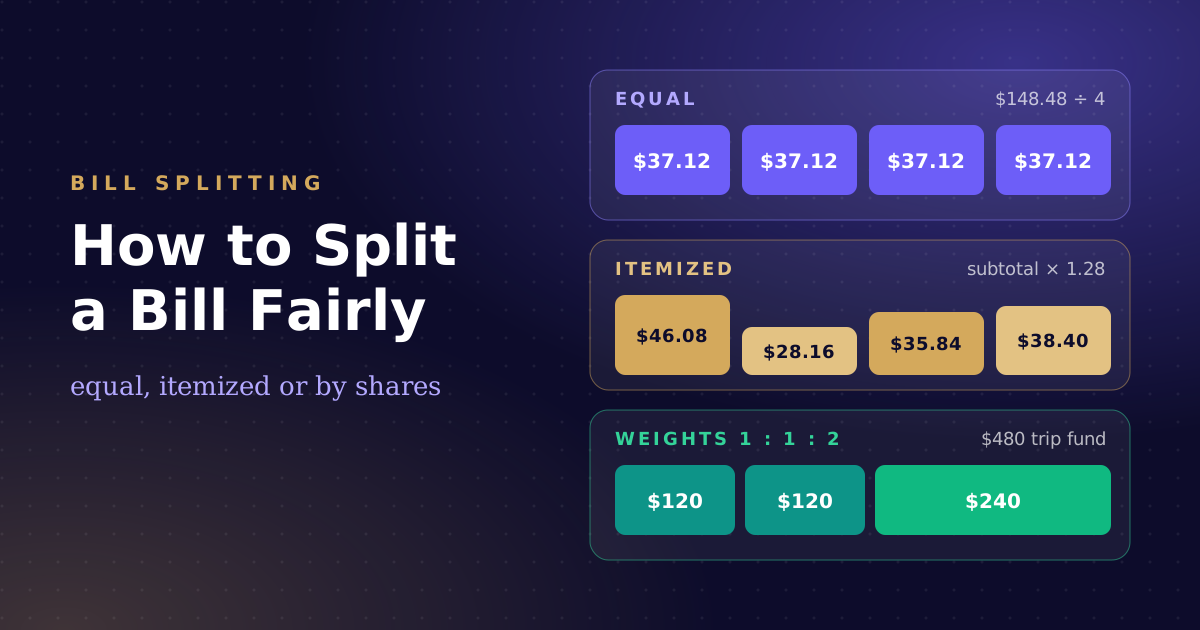
For a broader look at when equal, itemized, percentage or share-based splits fit best outside of rentals, see how to split a bill fairly.
Quick checklist before you book
- List the booking lines: nightly subtotal, cleaning, service fee, taxes, deposit.
- Agree whether couples pay per person, per room or a hybrid.
- Agree room weights for the master, private bathroom, small rooms and sofa bed.
- Decide how nights are counted and whether uneven stays use person-nights or night-by-night.
- Decide who absorbs leftover cents and who handles any withheld deposit.
- Write it down in the group chat so nobody has to reconstruct it after the trip.